
Between predictive analysis, conversational algorithms and new visibility metrics, DEJAN’s managing director maps out the future for anyone who wants to stay relevant
Let’s be honest: SEO is a mess. One moment you think you’ve figured it all out, and the next Google – or whoever – reshuffles the deck and you find yourself staring into the cosmic void of your analytics.
Frustrating, right?
That’s why, for the second episode of SEO Confidential, I decided to interview an international SEO expert I’ve been following for years, known for his consistently illuminating research on algorithms, machine learning and natural language processing techniques.
We’re talking about Dan Petrovic. A name that, if you move in high-level SEO circles, already tells you everything.
If you don’t know him, well, get ready.
This gentleman, straight from Australia, is the Managing Director of DEJAN, a digital marketing agency specializing in machine learning.
Here’s the point: we’re living through an era of staggering transformation.
Artificial Intelligence, LLMs… it feels like every day something new pops up to upend the rules of the game.
And the question hammering away in our heads is always the same, obsessive, almost annoying:
what on earth will become of SEO? Will it die? Will it turn into a three-headed monster that devours us all?
Well, we’re looking for answers.
Real ones.
And to find them, we go straight to the source.
Dan Petrovic isn’t just someone who “does stuff” with SEO.
He’s someone who dissects it. Algorithms, machine learning, Natural Language Processing: these are his tools of the trade. And he doesn’t stop at consulting: he teaches too, at university level.
He brings the trenches together with theory, practice with research. No big deal, right?
So, enough with the chit-chat and the resume-style introductions.
I had a chat with him. And what he told me… well, let’s just say it’s not the usual spiel about keyword stuffing and backlinks bought at the bazaar.
This is about science. About analysis. About truly understanding how machines think.
Don’t miss this conversation for anything in the world, because Dan offers a perspective that forces us to question a whole lot of clichés.
Ready? Then make yourself comfortable. Let’s begin.
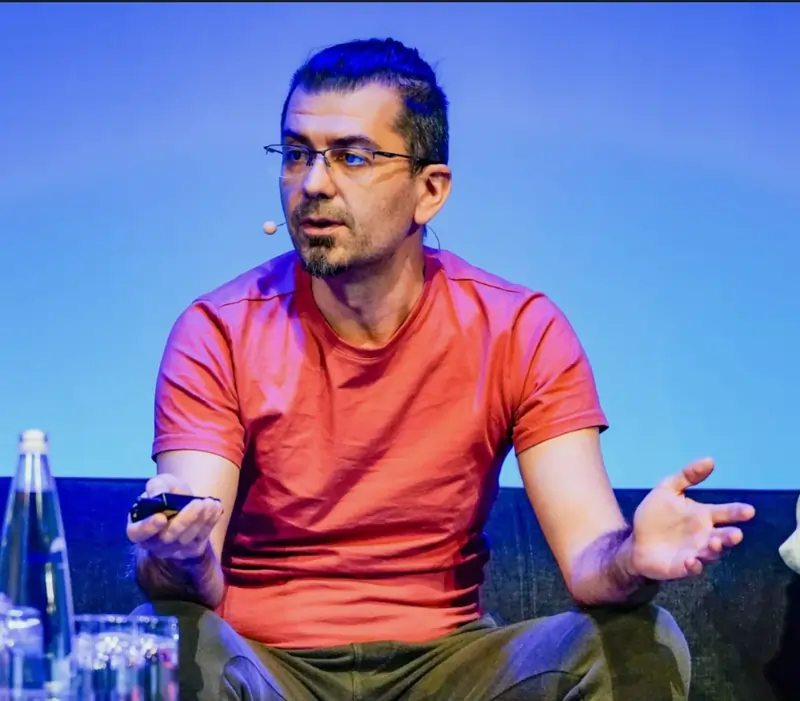
Dan Petrovic: “AI is not a fallback. It’s the future of SEO, but only for those who can look beyond the clicks”
Welcome Dan, today artificial intelligence seems to be on everyone’s lips. How do you see this sudden infatuation with AI applied to organic search? Is it the revolution we’ve been waiting for or just another passing fad?
I’ve always considered organic search a fundamental mechanism for branding, and over the past 20 years I’ve relied on it heavily. Thanks to artificial intelligence, this approach is finally going mainstream for many SEO professionals, but I believe those who join this trend merely as a fallback for lost clicks risk losing sight of the main goal.
You’re known for not mincing words. The web is saturated with content, often of dubious quality. According to some, AI could make things worse, while for others it could be the cure. Which side are you on? Will this “click tap” being shut off mark the end of content marketing as we know it?
The web is full of content, most of it mediocre. We don’t need any more of it. The entire content marketing industry turned out to be an anomaly inflated beyond all measure, producing content with no value or purpose, simply to generate clicks. Now that the tap is about to be shut off, the marketing industry might come back down to earth and do some real work.
So, if it’s not about churning out content or simple AI overviews, what is the future of search? Should we be worried?
Forget AI overviews, that’s not the future of search. The future of search is just as I predicted back in 2013. The user queries the index conversationally with an agent acting as an interface between the user and the information. I say agent because they won’t stay passive for long, and they’ll be able to act and do things for us. Anyone want a personal shopper? I think so!
In this new paradigm, how does the SEO’s job get redefined? Do we need to become AI tamers?
To make things even more interesting, there are strong signals that hyper-personalization is entering people’s browsers and mobile devices via edge computing and small, efficient models. So now our job is to influence both the AI and the user. The first layer is no different from traditional SEO. Information needs to be findable, accessible, and of high enough quality to be taken into consideration.
You argue that we need to understand what AI “thinks” about our brands. You even built a tool, right? Can you walk us through a practical example of how this analysis can lead to tangible results?
What’s new is that we need to start understanding what AI thinks about our brands. That’s why I created https://airank.dejan.ai/, which is now used by a huge number of people, and I’ll give you a practical example of how LLM analysis led to better results for one of my clients. We were trying to understand why ChatGPT and Gemini weren’t recommending Owayo when people asked for advice on custom cycling jerseys, one of their flagship products.
So we took the LLM visibility tracking data and ran an in-depth analysis, discovering that one of their main strengths was an obstacle to localization. In essence, the models hesitated to recommend Owayo because it wasn’t perceived as American enough, even though the company has a strong presence in the United States and regularly serves that market. This insight wasn’t immediately obvious, and it took considerable effort to probe the models and understand the full scope of the response probabilities. We used Google’s open source Gemma model for interpretability studies and then tried to draw parallels between it and Gemini.
You’ve even developed a “Tree Walker” algorithm. It almost feels like stepping into the field of computational psychology applied to marketing. How does this analysis of the model’s “intentions” work, in accessible terms?
“Tree Walker” intelligently analyzes all the possible directions a model can take in its answers about a brand. Armed with this new knowledge, we proceeded to “Americanize” the website and give the AI models greater confidence in Owayo’s relevance in the US market. A branding exercise.
So, big, already well-known brands start with an unfair advantage in the AI era, being already “in the heads” of the models. What about small ones? Are they doomed to remain invisible, or is there a way out, besides hoping for an “algorithm update” that includes them?
LLMs begin their journey in the pre-training phase, where they learn language and basic knowledge of the world. If you’re a big brand, or lucky enough to be a small brand still included in its initial view of the world, you have a huge advantage over your competitors. The model simply “knows” who you are and readily recommends you in chat sessions and various other modes of user interaction. For those who don’t live in the model’s “head”, there’s still a chance of being included through regular SEO. This is where retrieval-augmented generation (RAG) comes into play! At Google they call it “model grounding”, which gives their AI the ability to draw both on search results and on the direct URL content Google has stored for a page, in order to provide better recommendations. Finally, if you make enough noise as a small brand, you’ll be selected as a model’s internal knowledge during one of their fine-tuning events. You can think of it as the equivalent of a Google algorithm update. We measure and report these events to understand when Google updates its model’s knowledge.
This brings us to some practical advice for small businesses. You, somewhat provocatively, suggest abandoning traditional content marketing. A strong statement. What should they focus on instead, to avoid getting crushed?
My advice to small businesses is to forget traditional content marketing and focus on their products and services instead. Believe me, nobody wants to read your content anymore (unless it’s genuinely useful, ed.); focus instead on your commercial landing pages and make them extremely detailed, useful and interactive. Interactive? Yes, interactive. Google relies on user behavioral signals to understand which user experiences are engaging, and rewards them in search.
What’s the first basic step to figure out whether your brand is in the AI’s good graces or not?
Simple, just ask it: “What about my brand? Why didn’t you include it in the list of recommendations?”
SEO according to Dan Petrovic isn’t sorcery: it’s a science that demands method and data
Hey, let’s be honest: how many times have you thought SEO was some kind of black magic? Or a demon-possessed algorithm deciding your site’s fate with a roll of the dice?
Relax, you’re not the only one with these paranoid thoughts.
And so, after interviewing Francesco Margherita, for this second episode we went to hear from an expert like Dan Petrovic, whose research has stood out for years for its sharpness and clarity.
Dan took us by the hand to talk about today’s SEO: analysis, red-hot data, machine learning that learns faster than we do.
And you know what the gist of it is? Our craft, my friends, is more and more of a science.
On one hand, yes, the chaos is growing. That’s a fact, no point dancing around it.
But on the other?
On the other, we’re starting to understand things a little better. To see how these gears actually turn.
Less relying on lady luck, more strategies that work because they rest on evidence. Concrete evidence.
We urgently need to understand how these blessed algorithms think, not just tick off the shopping list.
Dan was crystal clear, even if he didn’t shout it from the rooftops:
today AI has flipped the table, so it’s vital to understand how the engines work. Not what they want today, but how they’ll think tomorrow.
You don’t win because you dug up the latest “secret trick” from some blog. You win because you spotted a pattern. An inefficiency. An opportunity that only the data, if you know how to squeeze it, can spit out for you.
The kind of strategy that doesn’t chase, but anticipates.
That’s the only way you make a difference. Really.
That’s the only way you build something that doesn’t collapse at the first gust of wind.
SEO Confidential: the interview series that challenges SEO clichés
This conversation with Dan is only the second stop on our journey. And I guarantee you: in every episode we’ll hear voices that carry weight.
Only experts with battle scars, people living inside the change who tell you, plainly and without sugarcoating, how to navigate this jungle.
Because, let’s look each other in the eye: we’re living through an era of epochal change.
The rules are being rewritten right now, as we speak.
And can anyone who does this job, or simply loves it madly, really just stand there watching the train go by?
I say no.
So: stay with us. Listen. Question things. Ask yourself the right questions (and look for the answers that truly matter, not the usual platitudes).
Because if it’s true that the future of search has already begun… well, then it’s time to sharpen your weapons. And to choose the right ones.
A thank you as big as they come to Dan Petrovic. For opening our minds and forcing us to look beyond our own noses.
See you next time.
#fullsteamahead