

In the era of agentic answers and AI engines, being “findable” is not enough: you need to become part of the conversations that lead to the purchase decision
Welcome back to SEO Confidential, the column where the world’s leading search marketing experts share analyses, strategies and visions on the future of online search.
After our conversation with Andrea Volpini, today we welcome Ina Toncheva, a strategist with 18 years of experience, consultant to tech companies and Fortune 500 firms, and founder of “AI for Content Marketing”, the lab that helps marketers become irreplaceable in the age of artificial intelligence. An authoritative voice who has been working for years to turn AI from a simple tool into a true competitive advantage.
With Ina we will discuss topics that directly affect every entrepreneur: what it means to write content that is clear and “readable” by AI, how SEO metrics change when clicks are no longer enough, and why visibility in the new engines like GPT-5 and Perplexity can determine the future of a brand.
We will talk about the invisible traffic that analytics cannot measure, the need for new KPIs such as AI visibility, and how content can become not just a source of traffic but a genuine conversion tool in a web where search is increasingly a conversation.
With our questions we wanted to get straight to the point: explaining in simple terms, to people who run a business, highly topical issues that directly affect their bottom line.
Ina answered with clarity and pragmatism, avoiding unnecessary jargon and offering valuable insights even to those who are not SEO or artificial intelligence experts but want to understand what is changing and how to navigate it.
So, without further ado, let’s get started!

Being cited by AI is the new business KPI
Ina, in your latest article you write that “Google rewarded suspense while AI rewards clarity.”
What does this mean for a company blog that aims to generate sales? How should content writing change to turn posts into real conversion tools in the era of AI Overviews?
Company blogs are far from dead, but they must adapt to how people now search for and consume information. The big shift is that content no longer has to serve human readers alone: it also needs to be structured so that AI tools like ChatGPT, Perplexity and Google AI Overviews can easily understand and surface it.
In the past, a blog strategy meant mapping topics to keywords, personas and funnel stages. That still matters, but there is now an additional dimension: AI search optimization. Blog posts should be written with clarity, direct answers and structures that make them “liftable” by AI systems, so that the brand shows up in the conversations where purchase decisions increasingly happen. This way, the blog becomes not just a source of traffic but a true conversion tool in the era of AI-driven search.
AI search reduces traditional clicks, because answers appear directly in the results or inside ChatGPT. For a business owner this means less traffic to the website. So how do we measure the value of SEO today, if the click is no longer the only benchmark of success?
The value of SEO today goes beyond clicks: what counts is visibility and direct business impact. That is why business owners should watch brand signals, such as online mentions and search demand, which reveal the level of awareness even when traffic doesn’t show up in the data.
A decisive factor is cost efficiency. Unlike paid advertising, SEO lowers customer acquisition costs and generates lasting returns. Conversions remain the benchmark: sign-ups, leads and sales are the concrete proof of the value created.
Then there is the issue of “invisible traffic”: visits generated by AI-powered search answers, which are hard to track with traditional tools. This is why it becomes essential to also measure AI visibility, that is, how often a brand appears within these new search scenarios.
You describe Answer Engine Optimization (AEO) as an extension of classic SEO. Which technical or strategic aspects do you consider most urgent for a company that wants to stay competitive across Google, Perplexity and ChatGPT search?
In my view, there are three priorities for staying competitive on Google, Perplexity and ChatGPT.
The first concerns content structure: open with a concise 40-60 word answer, use headings phrased as questions and organize sections so they can stand on their own, giving artificial intelligence clear material to extract.
The second is schema markup, which is now indispensable: adding FAQs with five to eight questions and answers, together with HowTo schema, helps surface direct information and step-by-step processes.
And then there are authority signals, which are becoming decisive: statistics, case studies and concrete examples strengthen the credibility of content and increase the chances of being cited.
Many business owners fear that AI will “take” their content without giving the brand any visibility in return. What do you think is the right approach: defending traditional organic traffic, or completely rethinking your digital presence strategy to be cited and recognized by AI?
Organic traffic isn’t disappearing: websites will continue to matter, especially for users deeper in the funnel. But we need to broaden the strategy.
In 2025 we will still see most companies focus on organic traffic, with 50-60% of marketing activities concentrated on content, SEO and managing the website as the central hub.
But by 2026 the balance will shift: brands will need to strengthen their presence beyond their own website, leveraging media and public relations, collaborations such as guest posts, people’s voices on social media — not just company pages — and even communities like Reddit.
This doesn’t mean abandoning organic traffic, but pairing it with a broader digital presence that makes the brand more visible and, above all, easier for AI systems to cite.
GPT-5 doesn’t simply show Google’s top results: it filters and reorganizes them according to its own criteria. Inevitably, this will reduce the weight of traditional rankings, don’t you think?
In your opinion, for a company investing in SEO, what is the priority (if there is one): ranking at the top of Google, or being recognized as a trusted source by AI?
It’s not a matter of choosing one or the other, but of making them coexist. Ranking on Google remains central, because the signals coming from there influence how AI systems evaluate and select sources.
At the same time, companies need to start thinking about a real AI-driven search strategy: content that is clear, trustworthy and structured so it can be easily recognized and cited. In practice, SEO remains the foundation, but the next step is becoming a credible source for AI: that is what makes content truly future-proof.
More and more we hear about content that helps users complete a task, and about brands building a genuine “personality” to be recognized by AI. How important is it, in your view, for companies to adopt this approach in order to be cited and remembered?
I think it’s a fundamental step. Artificial intelligence is starting to favor content that doesn’t just answer a question, but comes from a brand with a recognizable voice and a clear personality.
When there is a real person behind the ideas, content becomes more trustworthy and memorable, and that is what keeps people coming back. Not surprisingly, many brands are already leveraging figures with a strong personal brand: in a landscape saturated with generic AI-generated content, trust and authenticity become the real differentiator.
With AI Mode, Google has dismantled the very idea of a universal ranking: no more list of ten blue links, but agentic, hyper-personalized answers. In your view, Ina, how should companies change the way they measure their online visibility and their return on SEO investments?
Companies need to add AI visibility to their KPIs, alongside classic SEO metrics. This is not a marginal detail, but a signal that shows how often the brand is chosen and cited in AI-generated answers.
It’s still a young field, but tools like Semrush and Ahrefs are already integrating these analyses, while specialized solutions like RankScale.ai offer more targeted data. It doesn’t replace traditional SEO: it complements it. And it becomes essential for measuring a brand’s real authority in a search ecosystem that is rapidly shifting toward AI.
AI Mode no longer just reads entire pages, but fragments of content. This calls for a multimodal ecosystem of text, video, podcasts and structured data. How strategic is it for brands to adopt this “mosaic” vision of content in order to stand out in AI-generated summaries?
I’d say the mosaic vision of content is a great idea, but we also need to be realistic: every company has limited resources. It’s usually better to pick a few channels, get really good at them and start generating meaningful results before expanding. Once the foundations are in place, you can move into other formats, especially since AI tools now make creating, recording and editing video and audio much faster and cheaper.
Another smart way to expand your reach is through your employees’ personal brands: hire people who already have a strong personal voice and leverage that visibility to amplify the company. And don’t overlook the hidden talents of the people already working for you: if one of them already has a podcast, for example, they can become your ambassador in that space.
Data shows that Google is still the dominant search channel, but ChatGPT is growing at double-digit rates and drives referral traffic with higher conversions. From your perspective, how should companies that want to sell online read these numbers: is it really a matter of “complementary continents,” or is there a risk of more radical shifts in the medium term?
It depends a lot on the industry you operate in. The more digitally and tech-savvy your audience is, the more likely they are to adopt AI search quickly, which means ChatGPT may already be a significant driver of traffic and conversions.
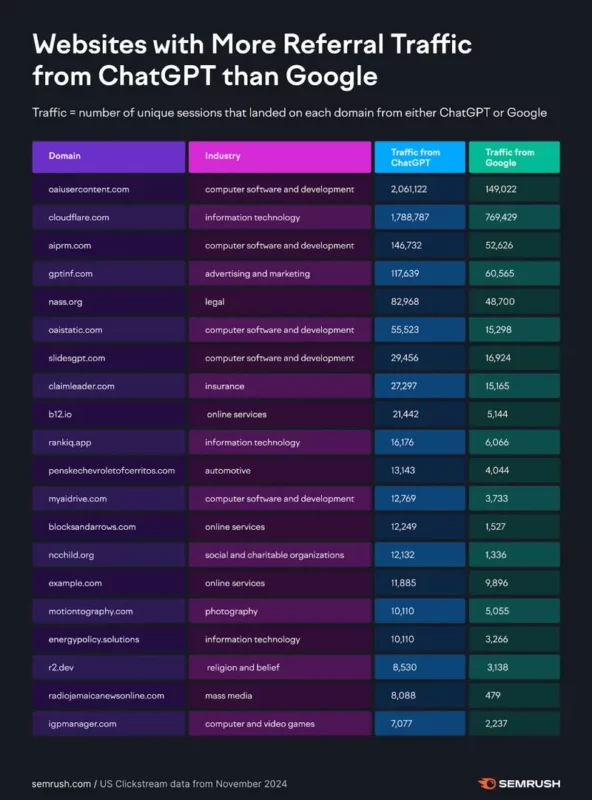
On the other hand, more traditional industries can probably count on Google remaining the dominant channel for a while longer. So rather than thinking of one replacing the other, I see it as a gradual shift that will happen faster in some sectors than in others. In fact, there are already websites getting more traffic from ChatGPT than from Google, a clear signal that for some audiences the balance is starting to change.
On Google, users search in a fast, fragmented way, while on ChatGPT search becomes a long, contextualized conversation that often leads to customers who are ready to buy. In your view, how should content strategy change to intercept these two very different behaviors and turn both into concrete conversions?
On Google, content still needs to be optimized for speed: clear answers, effective snippets and pages that quickly solve a specific problem. That is how you capture attention in a fragmented search journey.
On ChatGPT, the dynamic is different: people are engaged in a longer, more contextualized conversation and are often closer to making a decision. Here, your content should work more like a guide: structured, authoritative and able to build trust, so that when the AI summarizes or cites it, your brand appears as the natural next step.
The best strategy is to design content with both journeys in mind: create fast, easily consumable entry points for Google, but also develop in-depth, highly trustworthy resources that position you as the obvious choice in AI-driven conversations.
Together, they fuel both discovery and decision, turning search into conversions from multiple angles.
Google today provides less and less transparency on the data that really matters to SEO professionals. If in Search Console it is impossible to distinguish traffic coming from AI Overviews from traffic generated by AI Mode, how can informed decisions be made? And above all, what value can an SEO strategy have without the metrics needed to support it?
It’s true, Google now offers less transparency, so it is harder to separate classic search, AI Overviews and AI Mode. But this doesn’t mean SEO loses value: only the way we measure it changes.
Instead of relying solely on Google’s numbers, companies should monitor AI visibility with external tools, run experiments to test what works and focus on bottom-line results such as branded search, leads and conversions.
After all, SEO has always had a clear goal: ensuring visibility and trustworthiness when people search for information. Even with incomplete data, SEO remains a tool that lowers acquisition costs and supports growth.
Today the job of professionals is exactly this: interpreting fragmented signals, experimenting and making sure the brand stays relevant in a search ecosystem increasingly shaped by artificial intelligence.
SEO is the foundation, becoming a trusted source for AI is the next step
Our interview with Ina Toncheva reminds us of a truth that too often goes unspoken: complex concepts can be explained clearly.
There are objectively difficult topics around SEO and artificial intelligence, and it is fair to acknowledge their density.
But when this complexity turns into a maze of incomprehensible formulas and technical jargon flaunted as a linguistic barrier, we are facing the old vice of the “azzeccagarbugli”, the obfuscating lawyers of Manzoni’s The Betrothed: complicating what could be explained plainly, either because it hasn’t really been understood, or because the goal is to keep others from understanding.
With SEO Confidential, and with the collaboration of experts like Ina, we choose a different path: explaining clearly without trivializing.
Bringing layered, multifaceted concepts to light, while making them readable and immediately useful for people who run a business. Because an entrepreneur doesn’t have to become an SEO technician or an artificial intelligence engineer, but they must be able to grasp the impact these changes have on their business, their sales and their conversions.
The real value lies here: not in multiplying acronyms and buzzwords, but in turning technological trends into concrete guidance, into strategic choices that speak the language of business.
Because today the game is being played on two fronts: on one side, the contraction of organic traffic; on the other, the need to be recognized as a trusted source in the new AI-generated summaries.
The lesson emerging from this conversation is clear: the SEO of the future will not be an arsenal of techniques, but a work of digital reputation, credibility and consistency. Work that requires knowing how to interpret signals, experiment methodically and build content capable of surviving machine summarization without losing authority.
We thank Ina for helping us look beyond metrics and rankings, with simple, direct answers, exactly what we aim for here on SEO Confidential.
See you in the next episode! Get ready: we will have another unmissable guest…
#avantitutta 🚀