

With artificial intelligence the web is shifting from pages to entities, relationships and data: companies must build consistent information and adapt quickly
We are really happy to have Jono Alderson back with us on SEO Confidential.
A year ago he talked to us about reputation, trust and narratives built by artificial intelligence, and re-reading that conversation today you realize how much ground has been covered in twelve months. Impressive.
In this interview Jono walks us through an idea that will change your perspective: the web is shifting from pages to entities.
That doesn’t mean pages are disappearing, but their monopoly is — that much is certain. Machines today look at relationships, structured data and the provenance of information far more than they linger on a nice layout with a polished opening image.
Then there’s a concept that will probably sound familiar: “zombie companies”. These are companies that generate revenue, grow, hire and look alive and well, but are in fact strategically dead, coasting on advantages built years ago. Jono tells us how to recognize them, and above all how not to become one.
We also talk about data consistency across your website, LinkedIn, CRM and e-commerce, because that is exactly where your credibility is decided today in the eyes of an AI system. If the information doesn’t match from one platform to another, the AI stops trusting you — or worse, it makes up a version of you that doesn’t resemble you at all.
Well, maybe I’ve already given away too much: all that’s left is to wish you happy reading!
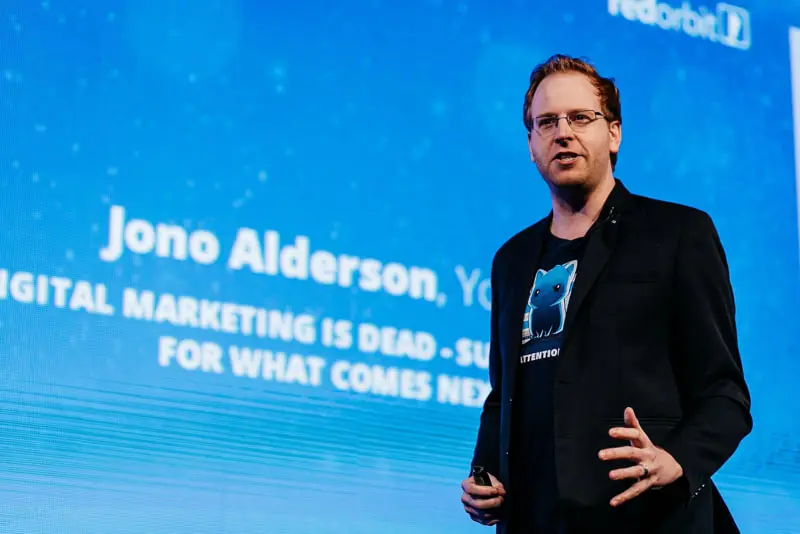
“People need narrative, hierarchy and design; machines need structure, disambiguation and evidence”, Jono told us
Jono, welcome back! It’s been about a year since our last interview and, in the meantime, the search landscape has changed profoundly: AI Mode, AI agents, new protocols and an increasingly central role for brands. Twelve months ago we talked about reputation, trust and narratives built by artificial intelligence. Today, what is the most important challenge an entrepreneur has to face to remain visible in the web that is taking shape?
The biggest challenge is speed: being able to change direction faster than the context around you changes. AI-powered search, AI agents, marketplaces, social platforms and answer engines are reinterpreting companies in real time.
If your brand, your content, your data and your decision-making processes move at the pace of quarterly meetings, you are already starting to disappear from the radar. Entrepreneurs have an advantage if they stay close to the market and avoid building miniature versions of the slow, political companies they claim they want to disrupt.
In your latest article you talk about “zombie companies”. What exactly do you mean by this term, and what are the signals that distinguish a truly healthy company from one that has already become a “zombie”, even if it keeps growing and turning a profit?
A “zombie company” is a company that is financially alive but strategically dead. It can keep growing, generating profits, hiring, making acquisitions and publishing confident press releases, but in reality it is mostly living off advantages built years earlier.
The signals are clear: slow decisions, internal politics prevailing over progress, a focus on appearances rather than results, and teams that no longer feel pride when things improve or shame when they deliver mediocre work.
Large companies can survive in these conditions for a surprisingly long time, but sooner or later a faster competitor comes along and turns what they considered their “competitive moat” into a mere footnote in history.
At what point does a company truly stop innovating and begin, perhaps without realizing it, to simply consume the advantages accumulated over the years?
A company stops innovating when, internally, the safest choice becomes preserving the existing machine rather than improving it. You notice it when taking a risk can put a career in jeopardy, while standing still is considered synonymous with professionalism.
In healthy companies, people keep debating quality, feel ashamed of poorly done work and maintain a certain willingness to face uncomfortable truths. In dying ones, by contrast, everyone has learned to stage progress while being very careful to avoid it for real.
With AI tools increasingly capable of comparing information from different sources, which inconsistencies risk penalizing a company the most? What should an entrepreneur take care of today to be truly credible in the eyes of customers and AI answer engines?
The most obvious inconsistencies are wrong addresses, old phone numbers, outdated logos and product pages long past their prime. The most dangerous ones, however, concern brand identity: different positioning across your website, LinkedIn, YouTube, sales pages, reviews and third-party platform profiles.
AI systems compare and synthesize all these signals and, when they find contradictions, they lose trust in the information or end up constructing their own version of the brand.
Today credibility comes from managing your entire digital presence, rather than simply polishing the homepage and hoping nobody notices everything else.
There is a lot of talk about standards like llms.txt, MCP and other emerging protocols. How much does a company’s data and content architecture matter today when it comes to adopting them quickly?
Taken individually, standards like
llms.txt, MCP and whatever else may arrive next week are not the central point. The real question is whether your architecture can adapt to new formats without requiring months of meetings, agency costs and existential crises.Content must be structured, reusable and interconnected, so it can be distributed across pages, feeds, APIs, structured data, files intended for AI systems and future protocols.
If every new standard requires a project built from scratch, you don’t have a technical problem: you have a fragile organization.
Many organizations have data spread across different CMSs, APIs, databases and management systems. How much does this fragmentation weigh today on the ability to make information truly accessible to AI answer engines and to adapt quickly to the new protocols that keep emerging?
Fragmentation is one of those boring operational problems that become existential the moment machines start synthesizing information about your company. A blog post should know the up-to-date pricing and availability of your products; an author’s new surname or avatar should update automatically everywhere.
If your CMS, CRM, e-commerce platform, documentation and marketing site each hold different fragments of the company’s reality, over time that information ends up diverging. At that point, AI systems stop considering you a reliable source or confidently describe a company that only vaguely resembles yours.
For over thirty years the web has been built around the concept of the page. Do you think this model is destined to remain central, or are we entering a phase in which the user experience will follow completely different logics?
Web pages won’t disappear, but their monopoly is ending. The page was a solution designed for people, inherited from the idea of the web as a collection of documents.
Machines are paying more and more attention to entities, claims, relationships, evidence and the provenance of information, rather than to whether content sits neatly at a single URL with a nice opening image.
We will see more and more database-driven experiences and content synthesized from multiple pages, sites, videos, feeds and systems.
Many fear that models could end up training more and more on content generated by other AIs. What consequences could this phenomenon have on the quality of answers in the long run? Do you think there is a risk of “model collapse“?
Model collapse is a real risk, but we shouldn’t pretend the web was a pristine library before artificial intelligence came along and dirtied its floors. Over the last twenty years we have produced shallow SEO content, rewritten explainers, low-quality affiliate content and texts written by people with no specific expertise and no real reason to write them.
AI-generated content accelerates the problem, but the deeper issue is training systems on poor, derivative material. The distinction to draw shouldn’t be between “human and AI”, but between content that does or doesn’t carry evidence, experience, judgment or something genuinely worth preserving.
With AI systems increasingly capable of understanding structured data and the relationships between pieces of information, how do you imagine we will design websites and interfaces in the coming years?
We will have to design websites less and less like brochures and more and more as structured information systems. The visible interface will still need to persuade people, but behind it there will need to be a clear structure made of entities, relationships, product data, author information, evidence, policies and context.
The page will become one of the possible representations of the system, rather than coinciding with the system itself. The best websites will look simple precisely because the most complex work will happen in the underlying architecture.
What role will HTML, structured data and semantic representations play in a web where people and AI systems consume the same information in completely different ways?
HTML will continue to play an important role because it is open, durable, accessible, linkable and machine-readable — qualities we naively keep underestimating. Structured data and semantic representations, however, will become the layer through which we explain what things are, what relationships exist between them and which claims can be considered reliable.
People need narrative, hierarchy and design; machines need structure, disambiguation and evidence (that is, concrete elements that allow a system to verify a piece of information and consider it trustworthy).
The goal is not to create separate content for people and for AI, but to build a single coherent information model, expressed in different forms depending on who — or what — is using it.
Which side is your company on? That’s up to you to decide
What a conversation, folks. Jono left us with an idea that is hard to get out of your head: the web is reorganizing itself around entities, relationships and consistent data, and companies that stay anchored to the old page logic risk becoming invisible without even noticing.
The part that struck me most is the one about zombie companies. They generate revenue, they grow, they look healthy, but inside they have already stopped moving.
Ask yourself this question: does your company move at the pace of the market or at the pace of quarterly meetings?
The answer says a lot about where you will be a year from now.
And then there is the consistency issue: website, LinkedIn, CRM, e-commerce — everything has to tell the same story. Because when an AI finds contradictions, it stops trusting you, or it makes up its own version of you. And that version might not appeal to you, or to your potential customers.
A huge thank you to Jono Alderson, as clear-headed and direct as ever. Who knows, maybe in a year we’ll catch up again to take stock, see who was right about all this and how search marketing will have changed.
See you next week with a new episode of SEO Confidential: I’ll be waiting for you!