

From Brand SERP to Answer Engine Optimization, Jason Barnard explains how online visibility is changing and why businesses need to become trusted sources for AI search engines
Welcome back to a new episode of SEO Confidential, the series where we meet the world’s leading SEO and GEO experts and ask them what really works.
Today, we’re joined by someone who names things years before the industry catches on: Jason Barnard.
If you work in online search, you’ve probably heard his name. In 2012, he was the first to talk about Brand SERP. In 2017, when hardly anyone was talking about AI engines that provide answers instead of listing links, he coined the term Answer Engine Optimization (AEO). Today, everyone uses it.
Jason is the founder and CEO of Kalicube, a Digital Brand Engineering consultancy operating across France and the United States. Since 2015, he has collected 25 billion data points on 73 million brand profiles and filed 17 patent applications with France’s INPI for systems that “train” AI engines. He has worked with Disney, Microsoft, Lagardère, ITV International, Orange, Yoast and SEMrush, to name just a few.
We asked him straight out how to get AI to recommend your business instead of your competitors. We talked about trust, keeping your brand’s online identity consistent, turning what your company already knows into useful signals, the weight of reviews and independent sources, and how to measure results that change with every search.
If you run a business and want to understand how to navigate the era of AI Search, this interview is pure gold. Take note of the answers, because you’ll need them.
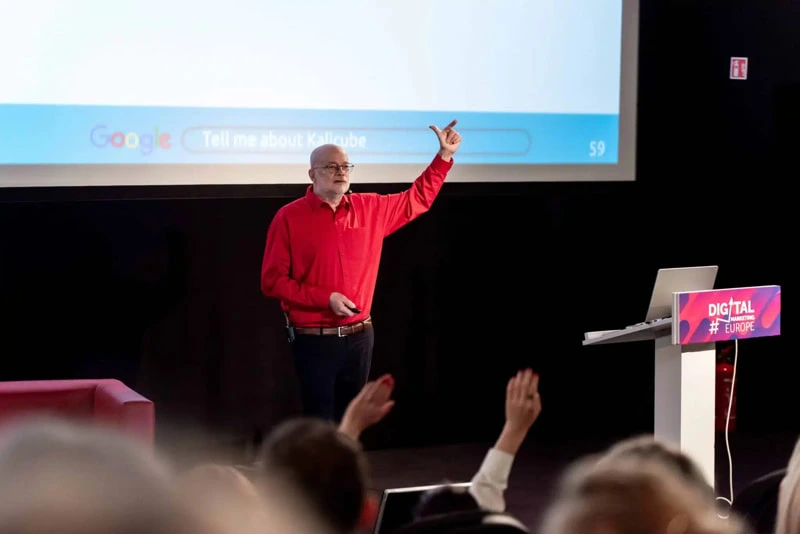
How to Get AI to Recommend Your Business Instead of Your Competitors
Describe AI search engines as an “untrained salesforce” that is already recommending brands to potential customers. What should a company do today to convince AI engines to sell its products instead of a competitor’s?
You have to start by understanding what an AI engine really is. In 2024, I called it the Untrained Salesforce. This isn’t a metaphor for a marketing channel. It represents a group of salespeople you’ve never hired, who work around the clock and pitch a company in your category to every potential customer who asks a question.
Every word in that definition has a precise meaning, but the most important one is untrained. These salespeople already know the entire category you operate in, and they talk to your potential customers every day. Yet nobody has ever sat down with them to explain what you sell. So they improvise. And a salesperson who improvises will end up recommending what they know best, which is often your competitor.
You can’t hire this salesforce, and you can’t fire it. You can train it by providing the most detailed, well-documented description possible of your company, what you do, and the customers you serve. You need to communicate this information more clearly and more frequently than your competitors.
Start at the bottom of the funnel, with your company’s identity. A salesperson who isn’t certain what a business stands for will never risk recommending it to a potential customer.
You’ve argued that the term “Generative Engine Optimization” risks describing a phase that is already becoming outdated, because AI agents won’t simply generate answers; they’ll act on users’ behalf. How should this shift concretely change the way brands create and optimize their content?
Generative Engine Optimization describes what the machine does at a particular moment. And that’s precisely the limitation of the term, because generation is a behaviour that will continue to evolve.
Just look at the sequence to see how everything is changing. In 2017, I coined the term Answer Engine Optimization, when machines began providing answers instead of simply listing results. In 2024 came AI Assistive Engine Optimization, as they moved from answering questions to making recommendations. In 2025, I introduced Assistive Agent Optimization because the next step for an assistant is to take action.
Action is the endpoint of this sequence. Once a machine has made a decision and purchased something on behalf of a customer, it has nothing left to do. AAO describes the role of the technology rather than its behaviour at any given moment. That makes it more resilient to future changes, whereas GEO risks becoming a term limited to a specific phase.
This means GEO is one component of the work, not an alternative strategy. If you optimize content to help an agent make a decision, the generated description will follow naturally. A machine confident enough to spend someone else’s money buying from you will also be able to describe your company positively, without you having to ask it to.
If you optimize only for the generated description, however, you can still lose the sale. A favourable description of your brand can easily coexist with a competitor’s checkout. A company reading its own glowing AI-generated summary might never discover which product the agent actually purchased.
The same evolution can be seen in clicks. In the traditional search era, we had the imperfect click: the engine showed ten options, and the person chose one. Then came the perfect click: the assistant suggested a single option, and the user confirmed. Now we’re entering the era of the agentic click, where the agent decides and purchases without the potential customer ever entering your funnel.
In practical terms, content stops being a persuasion tool aimed at a reader and becomes evidence for a decision-maker who cannot be won over by the charm of words.
Prices, availability, specifications, terms, guarantees, the customers you serve, and the customers you don’t serve must be stated explicitly, remain consistent across all platforms, and be machine-readable. An agent forced to guess will choose the competitor it doesn’t have to make assumptions about.
You’ve written that AI recommendations depend largely on the level of trust a system can build around a brand. So, what are the mistakes companies most often make that cause them to lose that trust?
The most common mistake is treating an AI response as a communications problem. The company prepares a rebuttal, publishes a press release, and waits for something to change. But nothing happens.
What an engine says about you reflects its assessment of what the world thinks about you. You can’t persuade it with flattery. You can only change the information it finds in the outside world.
The second mistake is starting at the top. Companies want to be recommended by the machine in competitive comparisons while it still has doubts about basic information and uses phrases such as “the company claims to be” or “describes itself as.” That uncertainty becomes a cost in every deal you’re involved in.
The third mistake is making claims without proving them. In April 2026, I published a paper on precisely this topic, The Framing Gap, available on Zenodo under DOI 10.5281/zenodo.19857447.
The pattern is so recurring that it deserves to be formally defined. Scattered evidence across the web produces no results. Connected evidence helps a little. Only evidence presented in the right context, so that the machine understands its meaning, can genuinely influence a recommendation.
A brand that publishes claims and stops there has built a case with no witnesses.
How important is it for a company today to maintain a consistent presence across its website, search engines, knowledge graphs, and external sources? And what challenges can a brand face when trying to build a recognizable and trustworthy digital identity across all these ecosystems?
It matters more than any other activity, because before recommending you with confidence, three different systems need to agree: the search engine, which indexes documents; the Knowledge Graph, which verifies facts; and the large language model (LLM), which reasons about concepts.
I call them the Algorithmic Trinity. Each of these three systems tolerates different levels of imprecision. A contradiction that a language model might overlook can be enough to block a Knowledge Graph.
The practical solution is to create an Entity Home: a page under your control that serves as the definitive source of information about your company, with all other platforms pointing back to it.
The difficulty usually isn’t technical. The problem is that nobody within the company manages the whole information landscape. The careers page was written by HR, the investor page by the finance department, the Crunchbase profile by whoever created it in 2017, and the LinkedIn description by an agency that has since been replaced.
Nobody is lying, but the machine is still faced with a company that cannot tell its story consistently.
Many companies possess a wealth of information generated through their day-to-day operations, from customer experiences to internal processes. How can they turn this knowledge into content and signals that help increase their visibility in AI Search?
It’s one of the most underused resources in the companies I analyse. The process has three steps: collect, organize, and distribute.
First, you need to collect what the company already knows: customer support requests, sales objections, questions asked during customer onboarding, reasons deals are lost, and the questions engineers answer every week.
Next, you need to organize this information into a single trusted source, so the company communicates one consistent version of its story instead of eleven different ones.
Finally, you need to distribute the content across your own websites, the platforms where you have a presence, and third-party websites that your industry actually consults.
When I analyse this information, I divide it into three groups. Some content already exists and simply needs correcting. Other content should exist because customers keep asking questions that nobody has ever answered. And some content can only be created after taking concrete action, such as conducting a study, obtaining a certification, or building a partnership.
Most companies already have years of information belonging to the first two categories stored in their customer support systems.
In AI Search, how much difference can reviews, articles, testimonials, and other independent sources make compared with content published directly by a brand?
They matter far more than you might think, and third-party data now demonstrates this.
In December 2025, Authoritas invented eleven experts and tested them across nine AI models using 66 questions.
When asked questions about their areas of expertise, where a recommendation was at stake, none of the invented experts appeared. When the questions were directly about their names, however, they appeared in roughly three out of ten cases.
This tells us something specific and useful: repeating a name across multiple sources helps build recognition, which is relatively easy to achieve. Getting a recommendation is much harder and requires sources you don’t directly control.
The invented experts had received press coverage, but they had nothing to support their credibility: no Entity Home, no documentation of certifications, and no track record of recognition from authoritative sources.
This is where public relations and technical work stop being separate activities. A press article that doesn’t link back in any way to your Entity Home is a citation that the machine may struggle to attribute to you. An unattributed mention can increase recognition without generating any recommendations.
So publish your own content, because it’s essential for defining your identity and providing context for everything else. Then invest your efforts in earning reviews, citations, interviews, and independent articles that can turn a claim into a verifiable fact.
Today, it isn’t always possible to know precisely why an AI system chooses one brand over another. So, what data and signals are most useful for understanding whether a company is increasing its visibility in AI Search?
Traditional search rewarded rankings, whereas AI rewards trust. That’s why you need to look at what the machine says about you, rather than simply counting where it says it.
Ask AI engines directly about your company and read their answers as if they were documents. This is what I call the AI Résumé, a company’s “résumé in AI”, a concept I formalized in the Journal of AI, Robotics and Workplace Automation in June 2026.
This document shows precisely where the machine is uncertain, which claims it questions, which information it reports incorrectly, and which competitor it chooses when information about your company is insufficient.
Then check your Brand SERP, the search results page Google displays when someone searches for your company’s name. It’s a term I coined in 2012 and remains one of the most reliable free diagnostic tools because it shows what Google thinks the world thinks about you.
Also monitor whether your content is cited as a source or simply mentioned. A citation indicates that the machine is using you as evidence to support its answers.
Finally, observe how the language AI uses to describe you changes over time. Moving from “claims to be” to “is” represents a measurable increase in trust, which often emerges months before your share of recommendations starts to grow.
In AI Search, results can change from one search to another and are harder to control than they are on Google. How should companies change the way they measure their visibility?
You need to stop measuring rankings and start measuring distributions. A single answer from one engine on one day is an isolated case. Treating it as a performance indicator pushes the team to chase random fluctuations.
You need to ask the same question in fifty different ways, using the engines your customers actually consult. Then count how often your brand appears, which competitors appear alongside it, and how the brand is described.
This gives you a share of recommendations based on a realistic set of potential customers’ questions, rather than a simple ranking.
Questions should also be segmented by intent. Queries about a company’s identity behave very differently from questions comparing competitors in the same category.
A brand can be perfectly recognizable and accurately described, yet never be recommended. That’s a completely different problem, and it requires a specific solution.
Response variability is another signal worth monitoring. If an engine gives a different answer every time, it means it hasn’t yet established a clear understanding of who you are.
Given this high degree of variability, how important is it to analyse data over longer periods rather than focusing on the results of a single day or week?
You need to look further ahead than you might like. The reason is simple: different engines don’t all learn at the same speed.
A search index is updated continuously, so a change to your website can have an effect within days. Knowledge Graphs and language models, on the other hand, update according to cycles that aren’t visible and that nobody publicly communicates.
This means that work carried out in March might produce results in July, without warning and without any way to attribute the outcome with certainty to a single activity.
This opacity is a structural feature of the system. You need to organize your work around it rather than trying to eliminate it.
You can monitor data every week to keep the team engaged, but you should never make a decision based on a single week. Likewise, two bad weeks shouldn’t be enough to overturn a strategy.
The reference period should be a quarter. The goal is to build trust, which accumulates over time. This cumulative effect is precisely what makes the difference: brands that are already well recognized become easier to understand with every update cycle, while ambiguous brands remain ambiguous until someone intervenes.
In the Age of AI Search, the Winners Are Those Who Make Themselves Understandable to Machines
If there’s one thing I’m taking away from this conversation with Jason, it’s that you can’t convince AI with words alone.
You convince it with evidence.
You can write the most compelling press release in the world, but if no one else on the web backs up what you say, to the machine, you’re still a company that “claims to be” something. And the difference between “claims to be” and “is” can be worth more than a thousand optimizations.
The second takeaway, in my opinion, is consistency.
Think about how many different versions of your company exist online today: your website, LinkedIn, Crunchbase, the pages your agency wrote three years ago. If you don’t bring them into alignment yourself, AI is left with a confused picture of your brand and, when in doubt, recommends the competitor with the clearest message.
Third, stop chasing individual answers. Responses change from one search to the next, so look at the overall patterns, think in quarters rather than weeks, and don’t panic over a couple of bad weeks.
And finally, here’s the good news: you already have most of the material you need. It’s in the questions customers ask your support team, the objections raised by your salespeople, and the doubts that come up every week. Collect it, organize it, and distribute it.
A huge thank-you to Jason for his time, his valuable insights, and such an enjoyable conversation. And thanks to you for reading all the way to the end.
See you next week for another episode of SEO Confidential. Don’t miss it!