

Pete Meyers tells us why being mentioned by ChatGPT is no longer enough: in AI Search what matters is the intent behind searches, the way a brand is talked about, and a new concept of sentiment we still need to learn how to measure
Welcome back to a new episode of SEO Confidential!
This time we have the pleasure of catching up with a guest we already had the chance to talk to a year ago, and we are thrilled to welcome him back: Pete Meyers.
If you work in SEO and data, the name probably rings a bell. Pete is Marketing Scientist at Moz, and his job is to make data cool, to show how valuable it can be — forget boring, endless tables.
He is convinced that the best ideas and the best data are worthless if you can’t communicate them, and that is exactly his mission: exploring strange, seemingly indecipherable data and telling its story in a clear, original way.
A year ago we talked with him about brand authority, artificial intelligence and the fight for visibility in AI Search, and that conversation left us with some amazing insights.
This time we raise the bar even higher: we find out why AI cares more about your intent than the exact words you write, why getting mentioned by ChatGPT is not always good news, and whether we should really worry about “model collapse“.
Pete never beats around the bush, and once again he doesn’t disappoint.
I’ll leave you to the interview — enjoy the read!
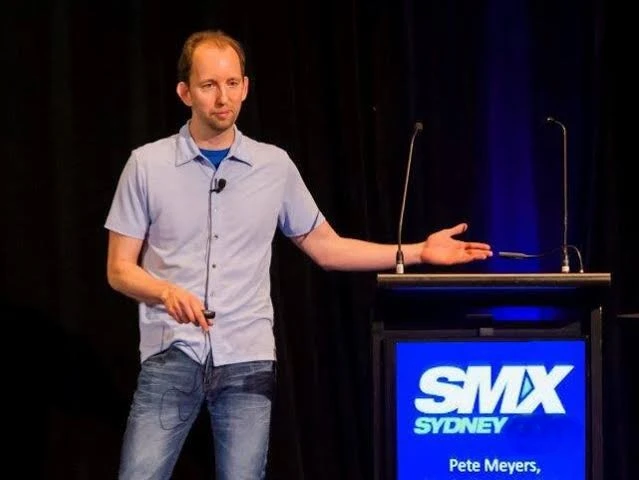
“Right now we are all losing clicks and it’s frustrating, but blocking content won’t turn back time”, in the very words of Pete Meyers
A study by Peec AI found that when we ask an AI engine a question, the AI considers our intent more important than the precise words we use. Do you agree? And what does it mean, in practical terms, for a company that wants to be recommended by artificial intelligence?
Not only do I agree, I think in 2026 this applies to search in general. It has probably always been the case, but we didn’t trust search engines enough to believe they could really understand what we wanted, so we were forced to use specific words (and, as a result, marketers were forced to write around specific words).
Ultimately, this allows us to worry less about the exact keywords we use and focus more on the user’s search intent. In my view, it’s a win for everyone.
The study also shows that when a user asks the AI to compare products or services, simply phrasing the same question in a slightly different way is enough to get different brand recommendations. Why does this happen, and how should companies prepare, in your opinion?
In my own work I haven’t seen such high variability, and I suspect much of this phenomenon simply comes down to the probabilistic way LLMs work. They still keep drawing from the same pool of brands and, most likely, these differences tend to even out over time and across repeated observations.
Personalization makes everything even more complex. To me, companies should focus above all on how their brand is represented in the broader corpus of information used by LLMs, without worrying too much about the differences that may emerge from one prompt to the next.
Many business owners celebrate when their brand shows up in ChatGPT or AI Mode answers. But being mentioned is not always an advantage: if the AI speaks negatively about a company, that visibility can hurt it. Could sentiment therefore become one of the most important metrics to monitor in AI Search?
I think this was already true for traditional organic search.
That said, as someone actively involved in sentiment monitoring, I’ll point out an important difference: today’s sentiment analysis systems were developed mainly to analyze social media mentions, where opinions tend to be more polarized.
LLM answers, on the other hand, tend to be phrased in a neutral way. That’s why, in AI Search, we will need to rethink both the way we interpret sentiment and the metrics we use to measure it.
With the arrival of standards like ARD, AI agents will be able to find products, compare them and even complete a purchase without the user ever visiting a website directly. What are the most important steps an e-commerce business should take today to avoid being cut out of these new sales channels?
I’m a bit concerned that, at the moment, the concept of “agentic” is still defined rather vaguely: agentic search will develop through specific use cases, implemented one at a time.
I think it’s worth staying up to date on what your own channels are using, including Google Shopping, without rushing to adopt standards that may never be applied in practice.
Google can’t afford to exclude important products and sellers just because their data isn’t perfectly structured, so it will have to be able to ingest and interpret as much information as possible.
Is it worth making this process easier for Google? Absolutely. Do you need to get ahead of every new standard someone proposes? No.
Many companies are considering blocking AI bots to prevent their content from being used to train models, at the risk of blocking Google too and losing visibility. How can you strike the right balance between protecting your content and the need to keep being found online?
I work with large publishers through our parent company and, right now, there is no easy answer. Setting aside sensitive information that could carry legal and financial risks, I think the risks of blocking content far outweigh the potential benefits.
Unfortunately, right now we are all losing clicks and it’s frustrating, but blocking content won’t turn back time.
What could be the most effective strategy for a company that wants to protect its content without becoming invisible?
I would say proceed selectively and, probably, start with small steps. You need to address the concrete problems that are actually happening, without chasing threats that may not even exist.
In the past I worked in the trade show industry and I met more than one business owner who refused to attend because he feared competitors might gather too much information about his company or steal his ideas. Then, however, he wondered why customers couldn’t find him.
It’s the same problem, simply amplified.
If artificial intelligence keeps feeding mainly on content generated by other artificial intelligences, do we really risk a progressive decline in the quality of answers? Is there a risk of “model collapse“?
I absolutely think the risk is real. There is also a further danger: compromising the entire content ecosystem. If people start feeling that their content is simply being absorbed and regurgitated, without generating any benefit for their business, why should they keep producing it?
I suspect Google is already worried about this scenario, even though it probably prefers not to talk about it openly.
It’s hard to tell whether we are already seeing the effects of this phenomenon, because the content explosion of the past decade has certainly created quality problems, and AI-generated content itself has plenty of critical issues in this regard.
I’m still not sure all of this actually comes down to LLMs ending up behaving like a snake eating its own tail: artificial intelligence generates new content that ends up online, other AI systems in turn use it as a source, and so AI risks feeding more and more on content produced by AI itself.
From keywords to sentiment: AI visibility increasingly depends on the quality of the narrative
And that brings us to the end of this conversation. What can I say? Pete never disappoints.
The biggest takeaway from this interview is a warning: stop obsessing over exact keywords and focus on what the user really wants, because that’s the first thing the AI looks at.
The sentiment point also gave me a lot to think about: being mentioned by AI is no longer enough — how you are talked about matters too, and on that front we still need to learn how to measure things properly.
My view on AI visibility has only grown stronger after this conversation.
It’s no longer about showing up as often as possible, but about showing up the right way. You could appear in every single ChatGPT answer, but if the story that comes out doesn’t represent you, you’ve only moved the problem, not solved it. The real challenge today is, as far as possible, to control the narrative, not chase the mentions.
A huge thank you to Pete Meyers for his time and his usual clarity — it’s always a pleasure to exchange ideas with him.
See you next week with a new episode of SEO Confidential — same place as always!