

“Being recognized, remembered and searched for online makes all the difference when traffic starts to decline”, Cyrus told us
For anyone working in digital, it is impossible to ignore: SEO is going through a profound transformation.
AI Overviews are changing the way users find answers on Google, and the first effects are already visible in traffic charts. Fewer clicks, less visibility, less room for editorial content. Meanwhile, millions of automatically generated pages are clogging the SERPs, making it even harder to stand out.
The question is simple and urgent: how do you get found on a web where content keeps multiplying, but attention stays the same?
That is where SEO Confidential comes from: a series designed for entrepreneurs, marketers and professionals who are not satisfied with the usual generic analyses. In every episode we talk with an authoritative voice in the industry to understand what is really happening, with practical advice and strategic vision.
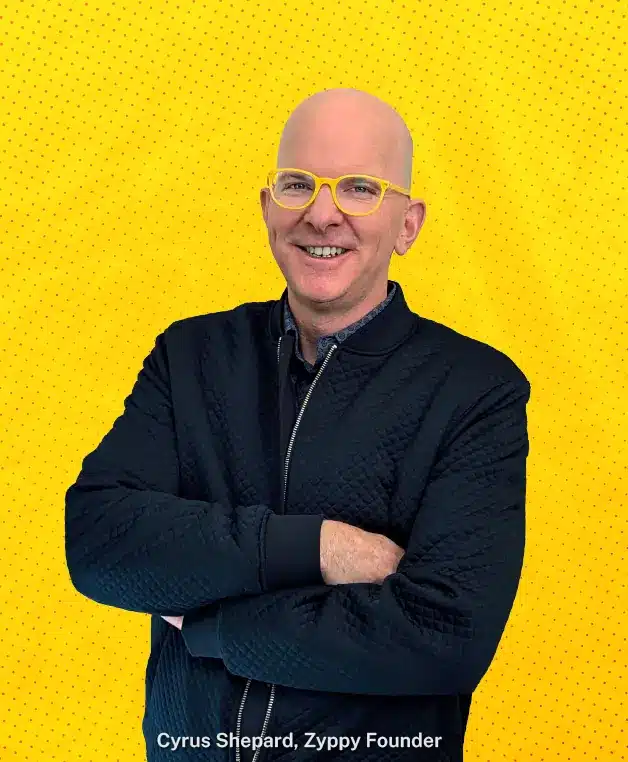
Today’s guest is Cyrus Shepard, a long-standing figure in international SEO, formerly head of strategy at Moz and founder of Zyppy SEO. Above all, he is one of the few who can turn trends, data and updates into operational solutions you can apply right away. Author, speaker, analyst, Cyrus is one of the most listened-to voices among people who work with SEO every day.
Who better than him to help us read the signals of the world’s most influential search engine? And above all, to understand where we are heading?
So without further ado, here is what Cyrus told us.
“Using artificial intelligence is perfectly fine, but you need to start from something AI alone cannot offer”
AI-generated content does not seem to be a problem for ranking on Google. Yet I have read that you often urge caution. What makes you think Google’s direction could change soon, even if the signals are not so evident today?
At the beginning of the year, Google updated its Quality Rater Guidelines, giving precise instructions on how to recognize and penalize content generated automatically or with AI. The problem is not artificial intelligence itself, but when it is used at scale and without human oversight. It does not take much to see where things are going: Google seems increasingly determined to crack down on mass-produced content with no added value or real supervision.
Google keeps stating its intention to reward “quality and authenticity”. But the efficiency of artificial intelligence is a strong temptation. What practical advice would you give today to content creators who want to use it intelligently, without ending up among those Google considers “scaled content abuse”?
I always tell my clients: using artificial intelligence is perfectly fine, but you need to start from something AI alone cannot offer. I mean truly original content, such as your company’s data, a webinar, an interview, a video, proprietary images. Everything that comes from real experience. It is the same principle that applies to content written without AI: if there is no unique value proposition (UVP), it is hard to stand out.
As we know, Google’s updates on this front are not immediate. What does that mean for those who are currently succeeding with AI content? Are they building a house of cards, a success based on rules that are about to change?
That is a very interesting question! My basic answer is this: the cost of producing “good” content is approaching zero for AI companies, including Google. If Google can generate an AI answer in a few seconds, why would it send users to your website for the same zero-cost content? In the long run, it will not.
The only real edge lies in content tied to proprietary assets: data, experience, original media, real people. If you can build on that, your work can keep its value over time.
Since Google is able to generate AI content, what incentive would it have to reward other people’s artificial content? Isn’t it more likely that it will choose to value the one thing it cannot easily replicate, namely authenticity and human experience?
Ha! We are thinking the same thing, then! Interestingly, my e-commerce clients are not seeing the traffic declines that other publishers are. Even though Google is hoarding traffic, the truth is that people still want to visit websites, they still want to buy products, read the news, participate in communities, watch videos, and so on. Google can try to keep all the traffic it wants, but for many things it will keep acting as a conduit.
Is it really that easy to manipulate the answers of LLMs like ChatGPT? What does this tell us about the coming “war” over the reliability of information online? Does Google have an advantage in this area? Are LLMs already starting to counter these manipulations?
Early experiments in the SEO/AI space show that language models are still fairly easy to manipulate, even with minimal effort. Google, compared to ChatGPT and others, seems more resistant, probably because it has more than 20 years of experience fighting spam behind it.
But spam is precisely the number one enemy for any search engine or content generation system, so it is inevitable that other companies will gear up too. Over time, therefore, it will become increasingly difficult to forcibly influence AI answers.
You argue that, paradoxically, the ease with which the new AI systems can be manipulated will push Google to give even more weight to its “traditional trust signals”. Could you expand on that? How do the classic elements of SEO, such as a site’s reputation and the quality of its links, become relevant in telling reality from fiction in the era of artificially generated answers?
In classic SEO there is still a golden rule: what others say about you matters far more than what you say about yourself. And this principle seems to hold in Google’s new AI Overviews as well. Google is very good at measuring the “consensus” around a piece of information, and it appears this is already a key element in AI-generated answers.
I have read that there is even a patent linking PageRank to the selection of trustworthy sources for AI answers. That is why I believe all the classic trust signals — reputation, quality links, citations — will become even more important. They will be needed to filter out mass-generated spam and to keep answers anchored to reality.
If the cost of creating content is now close to zero, are we entering a vicious circle in which machines learn wrong information from other machines? What impact will this have on our perception of reality online?
Yes, everything becomes garbage. I am certainly no expert on the subject, but the warnings from researchers about what AI is doing to our brains and the resulting lack of trust online do not look promising.
Cyrus, I agree with you when you say that “trust is gold”, especially on a web now flooded with junk content. In your view, will it be the big brands, the authoritative names or new indicators that allow Google — and us users — to recognize truly reliable information amid a sea of fake, low-cost content?
Google has been betting on “brand” signals for more than 20 years, and every year we see this trend getting stronger. The helpful content update gave even more weight to brand strength, and I believe this direction will become even more pronounced with the advent of artificial intelligence.
Having a brand that is searched for, recognizable and trusted is the number one defense against declining traffic. It is not an absolute guarantee, but it is certainly one of the few things that truly make a difference today.
In an industry obsessed with funnels and conversions, where you often hear that “clicks don’t matter, sales do”, you make an almost nostalgic plea in defense of the click.
With Google reducing traffic to external sites, what do you think is the biggest risk we run in losing this “engine” that, as you put it, has funded the free circulation of ideas and information for years?
I totally disagree with those who say “clicks don’t matter”. I have seen too many publishers lay off writers, downsize their operations and even shut down, because clicks are what pay the bills. The outlook for independent news outlets, already struggling, is frightening.
The consolidation of clicks onto an ever smaller number of sites like Google gives them frightening power. To counterbalance this, many AI companies are launching their own web browsers and the US government may force Google to sell Chrome. Hopefully this increased competition can help distribute traffic a bit more freely across the web.
On LinkedIn you wrote: “Not everything on the web has to end with a sale”. It sounds like a powerful manifesto against a purely transactional vision of the Internet.
But here is the paradox: how can this “magical”, non-commercial web sustain itself economically if the clicks that, for all their flaws, have kept it alive until now, are gone?
In short, it can’t. We are entering an era in which “facts” become a commodity, something that is bought and sold. What really counts are proprietary data, products, the brand and the people who put their face on it. It is marketing without the need for written content in the traditional sense.
And I will tell you the truth: despite everything I say, not even I really know what the future holds. Every day I get up, work with my clients and ask myself the same question: “How do we get the message across today?” And every day the answer changes.
The SEO that endures: be the source, not the result!
Cyrus Shepard was clear: aiming for the top spots is no longer enough. The real game is about becoming the source, not the garnish. In an ecosystem dominated by AI Overviews, you do not win by conquering a position, but by earning the trust of artificial intelligence.
It takes consistency and substance.
It takes content that tells something no one else can: lived experiences, proprietary data, well-founded opinions, original analyses that are genuinely yours.
That time you found a problem and solved it.
That strategy you tested in the field.
That time it worked.
That time it did not work (and what you did to make it effective).
That data point you collected over time, working on your product, your customer, your market.
This is what AI cannot generate artificially (without your input and the insights that come from your experience in the field).
And, above all, you need a brand that is recognizable, searched for, cited.
The future of SEO is a matter of authority. Google is no longer just looking for pages to rank, it is looking for fixed points. And those are built by whoever has a voice of their own, works on their reputation and manages to be chosen not because they are optimized, but because they are credible.
A heartfelt thank you to Cyrus Shepard for sharing such lucid and pragmatic reflections. At a time when everything seems fluid, uncertain and in constant motion, having a direction is already a form of competitive advantage.
See you in the next episode of SEO Confidential, as we keep exploring what really matters in the world of online search. Stay tuned.
#avantitutta