
The co-founder of 4WeekMBA tells us (among many other things) how the rise of AI agents is changing the nature of online traffic, disrupting established practices and opening new trajectories for brands and publishers
Some conversations help you clarify an idea, while others open your mind: they help you look at things from a different perspective, connect them, and understand that nothing happens by chance — everything makes sense once it is placed within a bigger picture.
The one you are about to read belongs, without hesitation, to the second category.
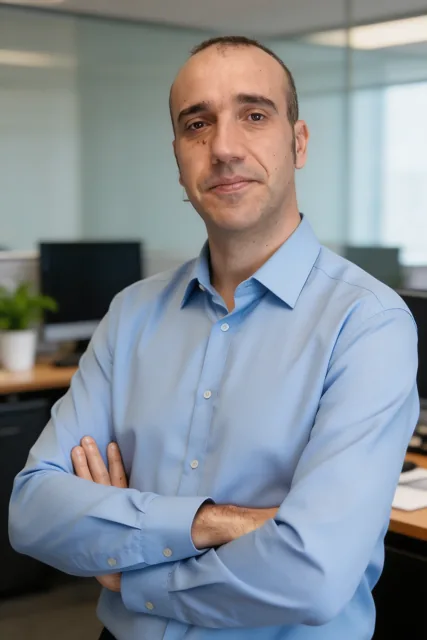
For the new installment of SEO Confidential, we had the pleasure of conducting a monumental interview with one of the sharpest and most widely followed minds in tech: Gennaro Cuofano.
As the creator of The Business Engineer, a newsletter with over 90,000 subscribers, he has spent a decade decoding the strategies of the tech giants.
Through his FourWeekMBA, a business education and research platform, Gennaro has built a point of reference for entrepreneurs, managers and anyone curious about the digital world: a place where theory meets practice and where every analysis translates into a real understanding of how modern entrepreneurship works.
Today, he is the one giving us his analysis of the biggest transformation the web has seen since its birth.
His will be a sharp, at times brutal, examination of the dynamics that are already shaping the future.
With Gennaro we tackled the questions every professional and entrepreneur is asking:
- Is Google destined to become a memory reserved for industry insiders?
- How do you create value when the web is no longer built for humans, but for AI agents?
- And, above all, which strategic choices must you make today to avoid being irrelevant tomorrow?
His answers are a concentrate of analysis and strategic vision. You will find no beating around the bush and no convenient predictions. Every argument is razor-sharp, backed by deep knowledge of tech business models and designed to provide concrete coordinates.
This is essential reading, whether you are a specialist looking for in-depth technical analysis or an entrepreneur who has to decide the future of their business online.
Get ready to question many of your certainties.
If there is one piece of content to read this year to grasp the real scale of the change underway, this is it.
A piece to study, not just to read.

“Every query that shifts to ChatGPT directly erodes Google’s business model, and the transition from informational to transactional traffic is only a matter of time”, Gennaro told us
According to Semrush, AI search could overtake organic search by 2028. If that happens, do you think Google will remain an indispensable player, or does it risk being marginalized?
In my view we are witnessing a radical transformation in user behavior that is making traditional search less and less central. Many in the SEO industry look at the data today, but often in a partial way: if we limit ourselves to traffic volume, we see that Google keeps growing, partly thanks to the ChatGPT effect and the like. But the reality is that these tools are expanding the use of the web and, at the same time, profoundly changing how it is accessed.
This shift represents the “BlackBerry Moment” of web search. At first the iPhone did not immediately shrink the smartphone market, but it changed the experience irreversibly: after touch, nobody ever went back. In the same way, every prompt made on ChatGPT undermines the foundations of traditional search.
There are at least three reasons.
First: a prompt is not a search. They are two different user behaviors, with different intents and expectations. With Google I look for information so I can act on my own; with a chatbot I ask the system to do it for me.
Second: precisely because tools like ChatGPT increase the web’s overall traffic, they become the new distribution platforms. Where I used to start my journey from Google, now ChatGPT becomes the entry point, while Google is used only as a “task completion tool”, to complete or verify steps the chatbot does not handle well. This qualitatively changes the use of search, increasingly limited to direct keywords (such as brands) or reliability checks. But as chatbots become more solid, even this role risks shrinking.
Third: it is true that at the moment chatbots mainly affect informational traffic, but this is a temporary phase. Controlling the top of the funnel is strategic because it influences the entire user journey, which is why Google supported the publishing ecosystem with AdSense for decades. Every query that shifts to ChatGPT directly erodes Google’s business model, and the transition from informational to transactional traffic is only a matter of time.
In short: yes, today chatbots are bringing more overall traffic to Google. Yes, today search still covers a significant share of commercial intents. But the way we use Google has already changed, and within ten years traditional search, while continuing to exist, will be a marginal market compared to the scale reached by AI search. As a consequence, it will no longer be able to sustain annual revenues of over two hundred billion dollars.
Alphabet will remain a top-tier company, even in the post-Google-search era, thanks to Gemini and its ability to compete in the AI market. But if the question is whether Google Search will remain Alphabet’s main engine, my answer is clear: no.
If Google stops being the primary distribution channel on the web and becomes a service complementary to conversational models like ChatGPT, what do you think are the deepest implications for the entire digital ecosystem, from publishers to advertisers?
If Google stops being the main distribution channel and becomes a service complementary to conversational models, the pipeline changes, and with it the way you position yourself. In my view we will find ourselves in a world moving at two speeds — or, to put it like Nassim Taleb, in a “barbelled” context.
(The “barbell strategy” consists of splitting a bond portfolio between short-term and long-term securities, avoiding medium maturities. It aims to get yield from long bonds and liquidity and flexibility from short ones, so as to better adapt to interest rate hikes. In the context of Google and SEO, the “barbell” idea points to a market splitting in two: on one side the giants like Google and OpenAI, on the other small, highly specialized publishers. Those in the middle, without the strength of the former or the identity of the latter, risk being cut out. Editor’s note.)
For decades, traditional SEO made it possible for unremarkable brands or aggregators — companies with no product but distribution only — to thrive thanks to their rankings on Google. In the same way, it also allowed publishers without a strong editorial line or a clear perspective on the world to succeed.
You did not need to be the Financial Times of your market: it was enough to know how to read search volumes and dominate informational traffic with “how to” content to build sustainable businesses. That era is over: that space has already been sucked up by the neural networks of ChatGPT and the like.
That is why in the AI era authority becomes central.
On one side there is the brand pole: today you can no longer build a business without clarifying what sets you apart. If you sell shoes, you cannot be yet another Chinese OEM: you must show craft, authenticity, clear reasons why the consumer should choose you. And to do that you must build direct demand through platforms like TikTok, Instagram, X, Reddit, creating awareness and differentiation. For publishers, branding means becoming the primary source of credible data, analysis and reporting in a vertical: the reliability of information is the new currency.
On the other side there is the technical pole. This is where players like Andrea Volpini’s WordLift come into play (here you can read our interview with Andrea, Editor’s note), working on knowledge graphs and open standards as possible navigation protocols for AI agents. This is the heart of the new web, which will be increasingly agentic: most traffic will no longer be human, but generated by language models that, thanks to reinforcement learning, have learned to use tools such as search itself.
In part, it is an extension of old-school SEO: having your technical parameters in order remains essential for discoverability. But AI agents do not work like a Google crawler: they do not simply collect signals from the page. They follow more complex logics, aimed at completing tasks for the user. And soon they will interact not only with the web, but also with each other, collaborating to plan and execute actions.
It is already a reality in the United States: agents that make purchases, book trips, carry out complex work tasks.
Such a scenario implies the emergence of two interfaces: one for the human and one for the agent. Today they coexist on the same web, but the trajectory leads to a future with a web invisible to humans, designed only for agents. This is where experiments on structured data, knowledge graphs and open protocols are concentrated. The challenge is not just technical: a new monetization model is also needed.
CPC was the pillar that made Google a giant, but in a web dominated by agents it is no longer enough. It is no surprise that Google is already working on an Agent Payments Protocol (AP2): a standard for agent-to-agent communication and transactions, indispensable above all in the transactional domain it cannot afford to lose.
In short, we are moving toward a “barbelled” Agentic Web: on one side strong, authoritative brands; on the other, technical standards and agent-to-agent protocols that redefine discoverability and monetization.
This is the new SEO.
There is growing talk of the possibility that ChatGPT will introduce paid advertising to ensure economic sustainability, given the model’s increasingly expensive structure. Do you think that in the future companies will have to pay to appear in the answers?
There is no doubt that advertising will remain fundamental to funding the web of the future. What is less obvious is that the current model — impressions and clicks — can simply be transplanted into an AI context. In the short term it is plausible, but looking at the next decade the direction is different: we need a monetization model aligned with the agent’s ability to guarantee a concrete result.
This applies both on the consumer side and on the enterprise side. If I ask my agent to find me the best combination for a flight to London in 30 seconds, it makes no sense for it to come back with ten options, three of which are “paid”. That mechanism does not work.
Likewise, if in a company I use an SEO agent for activities such as internal links, structured data, knowledge graphs or content, it makes no sense to receive a generic list of “sponsored” suggestions.
The model has to change: the agent should receive an economic reward only when it delivers a result aligned with my needs. This can happen through microtransactions (a commission on every successfully completed task) or through forms of feedback that improve the agent’s adaptation to my profile.
On the consumer side, one can imagine a model that replaces CPC (Cost Per Click) with metrics such as CPSA (Cost Per Successful Action). On the enterprise side, if an agent reduces tasks from hours to minutes with 90% accuracy and I, as an expert, can validate and approve, this too fits into the same scheme in which the subscription component will increasingly be flanked and then supplanted by the outcome-based one (still very complicated today).
In short: the next “Google” will not be a search engine but an agentic platform (one that lets agents find each other, “talk to each other” and interact in order to deliver results to the human), and its economic model will no longer be based on CPC, but on mechanisms capable of rewarding the alignment between agents and outcomes for the user.
If on one hand Google continues to guarantee steady volumes and revenues, on the other AI search brings more qualified traffic but with enormous fluctuations. In your view, should entrepreneurs embrace a hybrid model, or does the intrinsic volatility of AI risk compromising the sustainability of their businesses?
Absolutely hybrid, especially on the transactional front. If you have a blog that lived mainly on informational traffic, especially in the United States where the market moves faster, you already know that traffic has practically evaporated in a very short time. The emblematic example is Chegg, literally swept away by the new dynamic with Google.
Transactional intents, on the other hand, remain stable for now: they still largely flow through Google, which, thanks to the strength of its brand, remains a relevant distribution channel. But the pressure from Google itself — just think of the global rollout of AI Mode, integrated even inside the browser — shows that the trajectory is clear: Google Search too is becoming an agent.
For this reason, continuing to do SEO remains necessary. But if you do not want to risk seeing your traffic disappear overnight (something SEO professionals are unfortunately already used to), you must start building a presence in the new distribution channels as well.
Here a fundamental point emerges: the new AI search engines rely heavily on a brand’s ability to be cited. This will inevitably open the door to the usual distortions, such as fake Reddit accounts used to generate non-organic citations. But the real challenge is different: knowing how to build an authentic, recognized brand.
In short, there are two paths:
- the SEO who evolves into a marketer, able to build a brand with resonance, working on product and audience on platforms with a high virality index;
- the SEO who becomes a pure technician, specialized in deeply understanding the navigation dynamics of the AIs that are already rewriting the web.
Today traffic from LLMs is estimated to be worth less than 1%, it is not so certain that it converts less than organic, and it often generates errors that undermine users’ trust. In this scenario, is answer engine optimization a priority or mostly a market narrative?
The figure is quantitatively correct but, in my view, not qualitatively, because it overlooks a central point: Google’s strength has always been its ability to build an entire business model on attribution.
A great many transactions begin elsewhere — for example on TikTok, after seeing an influencer recommend a product — but are then finalized on Google. This is because Google controls Chrome, which remains the main access point to the web (not by chance, right now Google is extending much of its AI functionality inside the browser itself). In this way Google takes credit for the last step, even when the user’s journey began outside its ecosystem. It is on this logic that it built a money machine.
If we apply this mechanism to ChatGPT, the dynamic is already evident: many purchase conversations start from the chatbot today, but the user then completes the transaction through Google or Amazon. So the 1% share figure is quantitatively correct, but qualitatively misleading. The real effectiveness of answer engines like ChatGPT is already much higher, but invisible, because it is still Google or Amazon claiming the final sale. This, however, will change progressively.
As for errors, remember that we are still at the beginning. Until the end of 2024 ChatGPT was not even able to search the web; today it does, and it is already evolving in an agentic direction. The trajectory is clear and moving fast.
I understand that for those working in SEO the most reassuring narrative is “nothing changes”. But, in my opinion, that is precisely the most dangerous one.
Many analysts suggest treating AI search as a premium channel to run alongside organic, while others still consider it too unstable. Where do you think the main investments should go today: into consolidating traditional SEO or into an early opening toward AI search?
My view is that today you need to move on two tracks: keep working on the old model, but with a logic that projects you into the new one. In other words, the resources you invest in SEO today should be seen as a bridge toward AI search.
A practical example: classic activities such as sitemap cleanup, navigation optimization, link building, internal linking, structured data, or more advanced techniques that are niche today (but that tomorrow will become standard for agents) need to be rethought with this in mind.
For link building, you should not limit yourself to link exchanges, which have little value: you need to build partnerships and content that is relevant to your target audience (interviews, deep dives, market research).
For those working on internal linking, in my opinion, it is essential to move from generic keywords to much more specific ones, closer to the language of a prompt. If you produce research, it is better to link precisely to your sources and cite them clearly: this makes things easier for answer engines.
It is the same logic as crawl budget, only adapted to a token budget: how do I make sure AI chatbots find accurate, up-to-date information while consuming fewer tokens?
The same goes for customer support: FAQs are not just accompanying material, they become documentation that can feed AI searchability. Many tools, such as Claude Code, already draw on these sources today to carry out tasks on behalf of the user.
In short, a good portion of traditional SEO practices remains valid, but priority should go to those that work as a bridge between present and future.
AIs increasingly cite Wikipedia and Reddit, rewarding collective sources, while the documents from the Google trial show that what matters most is intrinsic quality and real interactions. Are we facing a structural shift in how trust is built online? Should companies really move part of their strategy from proprietary platforms to communities, or do they risk eroding their own credibility?
I do not believe the solution is for everyone to become Redditors or Wikipedia experts. Today AI engines use these platforms as data sources, both in the training phase and in real-time search, but over time the sources may change.
That is why it makes no sense to distort your brand just to “force” a presence on Reddit or other communities. A much more solid strategy is to work with publishers, influencers, or authoritative customers in your vertical, who generate quality content and conversations capable of then spreading organically to Reddit as well. These relationships become an asset you can control in the future.
What is more, platforms like Reddit are themselves turning into genuine engines, aiming to build their success on sharing community data to help brands position themselves inside AI interfaces. Not by chance, Reddit has just launched a new dashboard for publishers with the goal of becoming the intermediary of AI traffic.
In this context Reddit is already moving on several fronts, initiating a radical transformation also in the kind of insights it can offer on user behavior along the AI navigation journey. And this is precisely where the real turning point lies: the SEO toolkit will be enriched with new platforms and tools that will make it possible to intercept the new intent facilitated by AI.
The real risk, instead, arises when you try to improvise, adapting your brand to logics that do not belong to it.
Today the risk of getting it wrong and destroying your brand is very high, so you must always start from strategy and map the user journey.
Zuckerberg argues that those who do not use smart glasses could find themselves at a “cognitive disadvantage” compared to those who wear them. Considering the evolution of AI and Meta’s attempt to reduce its dependence on Apple and Google as gatekeepers, do you think smart glasses can really become the new privileged access point to the web, or will they remain a niche product incapable of displacing the smartphone?
I think so, and I hope so. I have been waiting for a truly solid AR product for over a decade, and the launch of Meta’s Ray-Ban Display is a step in that direction.
Even though AR interfaces could, over the next decade, supplant the smartphone (and in particular the iPhone), the reality is that it will take another 4-5 years before they become independent from the phone. Today, as the Ray-Ban Display case itself shows, the device presents itself as a companion: it serves for those actions that are inconvenient if you have to pull the smartphone out of your pocket.
In the same way that ChatGPT is eroding Google Search, these AR interfaces will progressively erode the smartphone. It will take time, but the trajectory is clear.
My thesis is that glasses are a bridge interface. The real revolution will be in neural interfaces, like Meta’s EMG wristband integrated with AR glasses, which will allow us to control the world around us without physical interfaces. Indeed, neural interfaces (for now Meta’s wristband only connects to our peripheral motor system) will be the true revolution and a symbiosis between human and machine.
But that is a twenty-year perspective. For now, the AR interface remains the fundamental piece.
With Hyperscape, Meta promises photorealistic replicas of physical spaces thanks to Gaussian Splatting and cloud rendering, but at the same time it opens the door to a detailed mapping of home environments and personal habits. In your view, are we facing a technological breakthrough destined to find real applications, or more of a Trojan horse to consolidate Meta’s control over users’ most intimate data?
Mean question 🙂
And yes, given its track record, I do not have much faith in Meta’s ability to truly keep our data private. And I will stop there.
A Pew Research Center survey shows a clear divide: AI is accepted in the office for functional tasks, but rejected in private life when it touches personal or relational decisions. If the distrust toward artificial intelligence stems from the fear of losing creativity, autonomy and relational skills, do you think big tech will manage to overcome this cultural barrier, or will AI remain confined to functional roles without ever truly conquering the personal sphere?
Absolutely. For me it is also a generational matter. Paradoxically, the younger generations are more aware of the limits of these interfaces, but at the same time they prioritize the speed of communication they offer.
For many teenagers these interfaces have already become genuine confidants. This gives us a window onto the future: a world in which AIs will become central tools, both professionally and personally. And there is no going back from there.
As I also explained in one of my analyses, I absolutely think that AI interfaces can cover the personal sphere even more powerfully than social media.
My thesis is that ChatGPT is not just a productivity engine, but potentially anything from a professional assistant to a personal confidant. Indeed, on the consumer side this is perhaps the most effective use case for scaling.
The reason is also technical: these interfaces are designed and trained to always be available and never disappoint the user. This, however, carries significant risks, because we are dealing with sycophantic systems that, in order to please the user, end up sacrificing the accuracy of information.
AI companies like OpenAI are aware of this. For now, even though they know this use case could scale very quickly, they are trying to limit it, precisely because they understand the responsibilities — including legal ones — that come with interfaces entering the personal sphere.
Looking ahead, the AI interface will be everything to its human: from technical assistant to confidant. There will not, however, be a single dominant AI, but an ecosystem made of multiple layers. Some providers will offer horizontal interfaces capable of covering both the professional and the private sphere; within these environments, however, there will be numerous sub-agents specialized in narrower tasks. We will therefore have a distributed ecosystem, not one absolute player.
It is striking that even 57% of industry insiders want more control over the use of AI in their lives. What does this paradox tell us about the real level of trust in these systems? And how can it influence the strategy of big tech, which aims to normalize the use of intelligent assistants in every area of daily life?
Although the paradigm is radically different from that of the web, which is an informational tool with distribution advantages, AI represents intelligence at scale that redefines the very value of things. Nevertheless, the adaptation path retains some similarities.
Many interfaces are introducing memory: on one hand it is decisive for personalization, on the other it opens up serious problems.
Clear rules are still lacking on the regulatory front. OpenAI’s own Sam Altman has confirmed that conversations with ChatGPT are not confidential the way they would be with a professional. If I share personal, legal or financial secrets, ChatGPT has no legal obligation to protect them under professional confidentiality standards.
This is an enormous problem and a delicate challenge. Clear opt-out mechanisms will be needed, and it will be essential for a large part of interactions to be handled on the user’s device, without passing through third parties. It is an important knot to untangle.
Meanwhile, AI platforms are specializing and we have now reached a strategic fork. If OpenAI aims to compete horizontally, also covering areas such as code generation that attract enterprise customers, it also knows it can become the next Google. For this reason its focus will remain strongly consumer-oriented, and we will see these tools become increasingly personalized and intimate.
Today you would never hand your smartphone to a stranger. Tomorrow you will not want anyone to know what your AI thinks, because that interface will hold information so intimate as to be comparable to a romantic or professional partner, all in the same product. Companies know this, and they are already working on the next physical interface that will take us toward a phase of greater symbiosis with machines.
It will be an exciting journey full of opportunities, but also high-risk and unpredictable. We need effective opt-out mechanisms and architectures that allow much more processing on the user’s device to limit the exfiltration of sensitive data. Only then can we balance deep personalization with the protection of intimacy.
You are no longer the one doing the searching: welcome to the era of your AI Agent
Reaching the end of this conversation with Gennaro Cuofano leaves a distinct feeling: that of having witnessed not a prediction, but a chronicle of a future that is already here. If there was any doubt that the search world was merely going through a period of adjustment, his analysis sweeps it away.
The era of businesses without a strong identity, built on Google traffic, is over.
What emerges is a polarized scenario, an “Agentic Web” where only the two extremes will survive: on one side, brands with real, recognizable authority; on the other, an impeccable technical infrastructure, designed to converse no longer with humans, but with AI agents.
What does this mean for you, working online?
The most powerful message Gennaro leaves us is an invitation to rethink every single action. You do not have to choose between the present of SEO and the future of AI. You have to use the present to build a bridge.
Every activity you carry out today — from link building to managing structured data, from content creation to community care — needs to be recalibrated.
The goal is no longer just to rank on Google, but to become a source so reliable and well-structured as to be the preferred choice of an artificial intelligence. The imperative, therefore, is no longer merely technical, but strategic and, ultimately, a matter of branding.
I called this interview “monumental” for its extraordinary completeness and clarity.
Gennaro dismantled every convenient narrative, offering an analysis that forces you to look beyond the next day’s traffic reports and rethink the strategy and relevance of your business over the medium and long term.
We wholeheartedly thank Gennaro Cuofano for sharing reflections of rare lucidity and depth, with no discounts and no shortcuts.
This is the mission of SEO Confidential: to provide tools to interpret change, not to suffer it.
See you at the next interview!