

“You don’t control how the web talks about you: you influence it. And influence comes from doing things worth talking about”
How many times have you searched for your brand on ChatGPT or Gemini? And what did you find?
If the answer is “nothing”, you have a bigger problem than any drop in organic traffic.
Welcome to a new episode of SEO Confidential, the series where we host the world’s most authoritative SEO professionals to discuss, with no filters, the future of search marketing in the era of AI-powered answer engines.
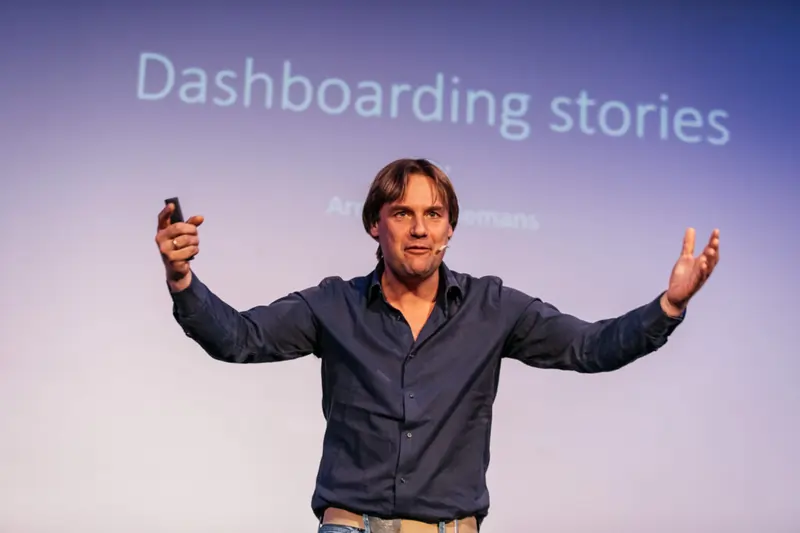
Today’s guest is Arnout Hellemans, an SEO, PPC and analytics consultant with a career built on real data, field testing and a chronic allergy to shortcuts. He works with companies of every size to maximize their online presence, with an approach that combines strategic vision and technical rigor. He is also the founder of OnlineMarkethink, the site where he shares analysis, insights and his experience in digital marketing.
In this interview, Arnout tackles the questions every business owner should be asking today: why organic traffic is declining and what it really means, which KPIs to monitor without obsessing over the wrong metrics, where budgets get wasted on fanciful, miraculous GEO services that promise the moon, and above all how to build real visibility in the age of artificial intelligence.
Few frills, plenty of practical insights. I recommend reading it in one sitting: you’ll find reflections and suggestions that are hard to find anywhere else, exactly the ones your business really needs.
“The brands that quietly kept investing in unmeasurable things, like brand, reputation, customer affection and point of view, are now the ones AI is rewarding”
Many business owners are worried about the collapse of organic traffic and fear AI cannibalization. What’s your take on this? Do you think these concerns are legitimate? And, above all, in an increasingly “zero-click” world, how can a brand stand out in the eyes of AI bots?
Forgive me, but I’d like to challenge that framing. Yes, fewer people are clicking, but calling this phenomenon cannibalization assumes the click was the thing of value. It wasn’t. The click was an indicator of interest, and we got so used to measuring the indicator that we forgot what we were actually looking for.
Standing out in the eyes of bots isn’t really a bot problem. Models synthesize answers from what the open web says about you, and that comes from the same things that have always built a brand: real customers having real experiences and talking about them, third parties writing about you because you’re considered authoritative, a consistent presence over years rather than months.
The brands that confidently show up in AI answers right now are mostly the ones that kept investing in brand and reputation while everyone else chased last-click ROI. They didn’t optimize for this; they’re simply reaping the benefits.
The technical side matters too: be indexable, be consistent on Wikidata and Wikipedia and on the directories relevant to your category, write content that actually answers questions instead of dancing around them. But that’s just the baseline. The real competitive advantage is that you’ve given the open web something true, consistent and useful to say about you.
Many companies look for shortcuts and end up going unnoticed. What really makes the difference?
Most shortcuts fail because they try to game a system that isn’t really a system in the traditional sense. There’s no algorithm to reverse-engineer, the way SEOs did with Google for twenty years. The model reflects an aggregated view of you in the user’s eyes, and you can’t get to a strong aggregated view by taking shortcuts.
What really makes the difference isn’t glamorous at all. A product or service people genuinely love and talk about. Customers who defend you on Reddit without being asked. Media coverage you didn’t have to chase. A founder or team with a clear point of view in your industry. Reviews that aren’t all five stars, but that sound like they were written by real people. None of this is new; it’s just suddenly visible again because AI is reading the same web we ignored for a decade in favor of dashboards.
The brands AI ignores are usually the ones that look great on paper: a clean site, good rankings, decent traffic, but no real story behind them. The web doesn’t have much to say about them, so neither does the model.
For a business owner, as we well know, the real issue is revenue. So let me ask you: which KPIs should you actually be monitoring?
Honestly, before giving a list, I’d warn business owners against KPI obsession. We just spent twenty years optimizing what we could measure and created a generation of marketers who can explain ROAS (Return On Ad Spend, how much revenue an ad campaign generates compared to what was spent, Ed.) to four decimal places, but can’t explain why anyone should buy the product. That’s the trap to avoid repeating with AI.
Track in moderation. LLM referral traffic in GA4 with a custom channel group, branded search trends, share of voice on a small set of prompts if you really must, the directional signal, a weekly overview, nothing more. The moment it becomes a board-level KPI, someone will start optimizing it and you’ll end up with the AI-search version of every dark pattern we’ve already lived through.
The only number that really matters is revenue and profit, and the truth is that all marketing, paid, organic, AI-driven, brand-driven or product-driven, contributes to it in ways that aren’t cleanly attributable.
The pre-analytics era understood this. You ran ads, did PR, took care of your customers, and revenue grew. We’re going back to something more like that, and I think it’s healthier. My advice is always the same: track just enough to know you’re not going backwards, and put your energy into doing things worth being known for.
Share of Voice in LLMs, that is, a brand’s share of visibility compared to its competitors, is increasingly monitored by companies and marketers: how do you actually measure it in practice, and what are the limits of these metrics?
Today there are solid tools like Peec, Otterly, Profound and LLM Pulse, which all do more or less the same thing: run sets of prompts across different platforms, count brand mentions and calculate the share. The mechanism works well. My concern is what happens to that number once it lands on a dashboard.
The moment an executive sees “AI share of voice: 12%” next to “competitor: 18%”, it becomes a target and someone gets tasked with closing the gap. That is exactly the wrong response. The competitor at 18% probably got there because they spent five years on the groundwork, on product, PR, community and customer experience, the things the model now reflects. You can’t catch up by optimizing prompts; you catch up by becoming a brand worth mentioning.
So if you’re going to track it, treat it as a thermometer, not a target. Use a small, stable set of prompts, watch the trend over months, not weeks, and use it to ask better questions: why are we mentioned in this context but not in that one, what does the model think we do, where is the gap between what we say about ourselves and what the web says. That’s directional intelligence. The percentage itself is mostly a vanity metric.
The market is teeming with promises like “get into ChatGPT’s world”. What are the most common mistakes that send budgets up in smoke?
The biggest mistake is buying into the idea that there’s something to buy. Most of the “GEO services” currently on sale are nothing more than content marketing with a new label, and they’re pitched to people with underlying brand and reputation problems that can’t be fixed with twenty more blog posts. If your customers aren’t talking about you, no amount of optimized content can fix that.
The second mistake is treating AI search as a standalone strategy rather than an integral part of everything else. It isn’t. The same things that build a strong brand build a strong AI presence: product quality, customer experience, third-party validation and consistent communication. If your AI strategy is disconnected from your CX (customer experience, Ed.), your PR and your product roadmap, you’re working on the wrong layer.
The third is over-investing in measurement before doing the work. I’ve seen budgets go to dashboards and monitoring tools while the underlying brand is invisible on Reddit, has 12 reviews on the platform that matters in its category and a Wikipedia entry that hasn’t been updated since 2019. The dashboard won’t fix that.
Finally, be wary of anyone promising fast, guaranteed inclusion in ChatGPT or any other model: that’s not how non-deterministic generative systems work, and selling it as if it were should be a red flag.
With the arrival of ads in chatbots, the line between organic and sponsored content is getting thinner. What is the impact on trust and conversion?
Honestly, it’s too early for data-backed answers. OpenAI only started testing ads in February.
Here’s what I think, though: as long as ads stay outside the body of the answer, clearly labeled and visually separated, users will probably tolerate them the way they tolerated Google’s first sponsored links. The day a paying brand starts appearing inside the AI’s list of recommendations without any disclosure, trust will collapse quickly and probably never come back. That boundary is the key element.
As for conversion, I expect being recommended by the AI within the answer to far outperform being shown next to it, because the implicit endorsement is the asset. A labeled ad can’t replicate “the AI thinks this is the right answer”. So sponsorship will work as a top-of-funnel awareness play, but it won’t replace being part of the actual answer.
The longer-term concern is the trajectory of Google’s SERP, clean in 2002, saturated with ads in 2020. If the same drift happens here, the conversion premium will erode as the format matures. Worth keeping an eye on, but no reason to panic just yet.
So let me ask you: when does investing in chatbot/AI advertising actually make sense? Do you think it’s too early?
It makes sense in situations where you genuinely don’t have time to build organic citations. New product launches, new category creation, geographic expansion into a market where you don’t yet have an established presence, or defensive plays against a competitor dominating organic AI mentions. In all of these cases, ads can secure an immediate presence while the slower work proceeds in the background.
When it doesn’t make sense: anywhere you’re paying to sit next to your own organic mention, in commodity product categories where the margin can’t absorb the CPM (Cost Per Mille, a metric indicating how much it costs to show an ad to users a thousand times, Ed.), or in any awareness play without the basic measurement to know whether it’s working.
The test I’d apply to any chatbot ad spend is this: if you switched it off after twelve months, would the visibility persist? If yes, it was probably a bridge to something organic. If no, you were renting attention, not building anything.
If a brand doesn’t actively build its own narrative, AI will end up defining it by drawing on external sources: which concrete actions really make the difference?
This is where the discussion gets interesting, because “controlling the narrative” is, in a sense, a marketing fiction. You don’t control how the web talks about you; you influence it. And influence comes from doing things worth talking about, as well as making sure the fundamental data is correct exactly where AI goes looking for it.
In practice, that means a few things in parallel. Make sure your baseline data is clean, for example: Wikipedia, Wikidata, Crunchbase, LinkedIn, your Google Business profile, the directories relevant to your industry and the review platforms where customers actually look. These feed the model’s understanding of who you are at the entity level, and they’re often wrong or outdated for brands that otherwise look well curated.
Then there’s the real work, which happens mostly outside SEO: a customer experience that produces quotable customers, product decisions that generate organic word of mouth, a founder or team with a visible point of view and genuine participation in the communities where your category is discussed. SEO can flag the gaps and surface the signals, that’s a supporting role, but increasingly the SEO conversation has to push into UX, CX and product, because that’s where the inputs actually live.
Some clients have asked me how to rank for X, and the honest answer is that ranking isn’t the problem. The problem is the experience the product delivers, which is generating mediocre reviews, and no on-page fix can solve that.
It’s also very important to address negative narratives head-on when they exist. If a real concern shows up in autocomplete suggestions, the same question is probably being asked of ChatGPT too. Prepare a substantial, honest answer and put it somewhere on your site. Silence loses; defensiveness loses; calm and precision win.
Traffic from LLMs is still small, but many argue it converts better than other channels: how much of that is true, and what does it depend on?
I’d start by questioning the headline numbers. Semrush’s 4.4x multiplier gets quoted constantly, but Amsive ran a comparative study across 54 sites and found no statistically significant difference.
Academic research on ChatGPT e-commerce referrals actually found lower conversion and spend than traditional channels. So the claim that “LLM traffic converts better” is true in some categories, false in others, and overblown as a universal rule.
Where it is true, generally in B2B and considered purchases, the mechanism is simple. The user has been pre-qualified by the chat itself. Their basic questions have already been answered, their objections addressed, and the alternatives compared. By the time they click, they’ve already decided to act and they land on bottom-of-funnel pages, not the top.
But I’d be careful not to get too excited about that number. The volume is tiny, under 1% of sessions for most sites, and much of what looks like LLM influence actually shows up as branded search or direct traffic, because the user hears about you on ChatGPT and then types your name into Google.
That’s the conversion event the dashboard doesn’t catch, and it’s probably bigger than the LLM referral number itself. Which brings us back to a central point: instead of focusing too much on what’s hard to attribute precisely, it can make more sense to understand whether overall brand demand is growing in the direction you want.
Sources like YouTube, Reddit and content based on real experience seem to carry growing weight in LLM answers: in this scenario, how do you think SEO should concretely evolve?
I believe SEO is going back to being something closer to marketing, which is a good thing. Over the past decade or so, SEO became increasingly technical, focused on keywords, structured data (schema markup), internal linking and on-page experience. All true, all useful, but disconnected from the bigger question, which is: why should anyone care about your brand?
Artificial intelligence is closing that gap because the model rewards signals that come from outside the SEO bubble: community presence, real customer voices, original expertise, video, founder visibility and product experience.
The technical foundations of SEO remain, but they become the price of entry rather than the differentiator. The interesting work moves into territory that historically didn’t belong to SEOs: community strategy, YouTube, PR, original research, customer experience signals, the parts of CX and product that determine what people actually say about you. SEO becomes a support function or, in better setups, a driving force pushing the rest of the organization to invest in things that build the brand.
The most significant shift is philosophical. We’re coming out of a period when the motto “if you can’t measure it, don’t do it” was treated as a principle of wisdom. It wasn’t at all; it was more of a defense mechanism for a generation of marketers trained to optimize whatever the dashboard could show.
The brands that quietly kept investing in unmeasurable things, like brand, reputation, customer affection and point of view, are now the ones AI is rewarding. SEO’s job, increasingly, is to help organizations rediscover that the only number that has ever truly mattered is revenue and profit, and that almost everything driving them is harder to attribute than we’ve pretended for the past twenty years.
AI didn’t invent new rules: it made visible those who have always done the work well
This interview with Arnout Hellemans gave us a lot. We asked the hard questions, the ones every business owner asks when traffic drops or when they hear about AI visibility, and Arnout answered with rare clarity and precision. No beating around the bush, no vague answers: just solid concepts, built on years of work in the field and a vision of digital marketing that always puts real results at the center.
What struck us most is the consistency of his thinking. From the first paragraph to the last, the through line never changed: visibility in the age of artificial intelligence can’t be bought and can’t be shortcut into existence. It’s built over time, with a product that works, customers who speak well of it, and a reputation the open web can reflect. AI didn’t invent new rules: it made it more obvious who has always played the game well.
For anyone running an online business, the practical takeaways from this interview are invaluable. Keep an eye on brand demand, don’t obsess over dashboards and secondary KPIs, be wary of anyone promising quick results on AI search, and invest in what generates authentic conversations around your brand.
It’s not the answer many want to hear, but it’s the right one.
Heartfelt thanks to Arnout for the time he gave us and for the quality of his answers. Hosting him in our series was a great pleasure, and we’re truly glad to have shared his point of view with you.
See you at the next episode of SEO Confidential, next week with another guest of international standing.
#avantitutta