

From QR code payments to advertising-driven search, the Chinese market is showing trends that could eventually make their way to the West
For this new episode of SEO Confidential, we had the pleasure of chatting with Natalia Witczyk, a truly international SEO consultant, not just in name.
Natalia is an International SEO Consultant and CEO of Mosquita Digital, with more than ten years of experience working on international projects across Europe, Asia, the United States and Latin America. She is also an Associate Professor at TBS Education, where she teaches e-commerce SEO, web analytics and technical SEO, and serves as a judge for the Search Awards (EU, Global and UK).
She lives and works in China, giving her first-hand experience of two worlds, Western and Asian, that are often too different to be compared directly. In short, she doesn’t study the Chinese market from reports: she experiences it every day.
We talked to her about QR code payments that could permanently change the way we use cards such as Visa and Mastercard, advertising that literally tells users what to type into the search bar (yes, you read that right), and the often underestimated differences between Google and Baidu, which are anything but “the same thing with a different logo.”
Natalia shared very practical advice on how to monitor a brand’s presence across AI systems, as well as what really matters, and what is merely a vanity metric, when it comes to visibility in the age of GEO.
Thinking about expanding your business into China? Then this is essential reading.
But even if you have no plans to do so, keep your eyes open: trends that emerge there often reach us a few years later. It’s better to be prepared, especially when your brand’s visibility is at stake.
To put it simply, if you want your brand to be visible in the age of AI search, and you want your company to be recommended by ChatGPT, Gemini or other LLMs, this interview is for you.
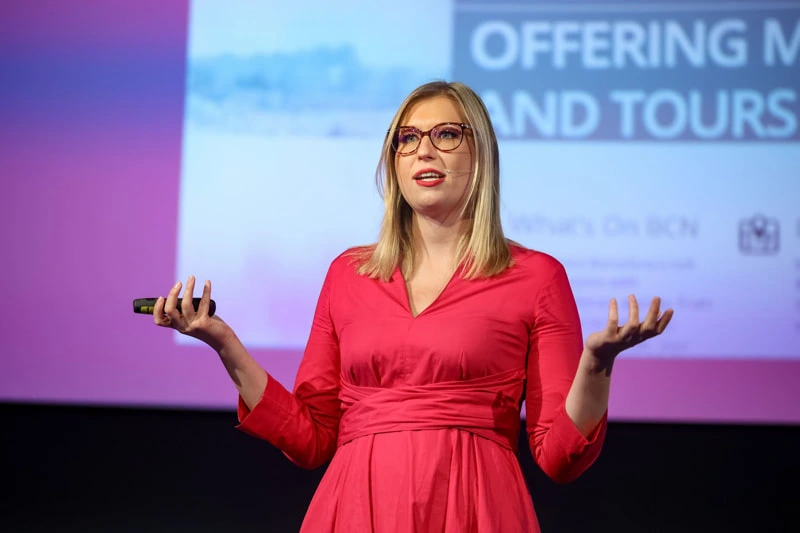
Here you can find Natalia’s answers in video format:
Below, you’ll find the transcript of our interview with Natalia Witczyk. Enjoy the read!
When advertising already tells you what to search for: what is happening in the Chinese market
You mentioned that the way people search for information in China was already changing before the arrival of artificial intelligence. Which changes have struck you the most? Do you think the West will follow a similar path, perhaps a few years later?
The most interesting trend I have experienced while living in China is definitely payments. China essentially skipped the widespread adoption of debit and credit cards as we know them in Europe. Contactless payments and card-based systems never really became central to everyday life.
Instead, the country adopted QR code payments on a massive scale, mainly through two systems: Alipay and WeChat Pay. They are now virtually everywhere. You find them in shops, taxis and even among street vendors selling fruit, vegetables and fresh produce. Basically, anyone selling something can have their own QR code printed on a simple sheet of paper, often with Alipay and WeChat Pay codes displayed side by side.
The system is extremely simple and works very well. Even for a foreigner visiting China for the first time, using these services is relatively easy: you simply create your account and verify your identity before you can start making payments.
I believe a similar model could eventually reach Europe, especially because it could reduce dependence on traditional networks such as Mastercard and Visa, as well as the costs they impose on businesses for every transaction.
There is another interesting development worth watching. ByteDance, the company that owns TikTok and its Chinese version Douyin, recently applied for a banking license in Brazil. Brazil could potentially become a test market for experimenting with new financial services and payment systems on a large scale before expanding into other Western markets.
That’s why it is worth keeping a close eye on what the major Chinese super apps are doing. They could try to bring one of the areas in which they have developed the strongest expertise in China to our markets as well: digital payments.
Since you have been living and working in China, you have had the opportunity to observe two very different digital ecosystems. Are there trends that originated in China or elsewhere in Asia that you think will soon reach Europe and change the way SEO is done?
There is a search-related trend that I have observed in China and that I think we should also keep an eye on in the West, because it could reach us very soon.
Some service providers, restaurant chains and B2C platforms use advertising, both print and digital, in public spaces to guide users directly into a search. The ad displays a search box with the name of the app or service to use and, often, the exact keyword to enter.
The mechanism is simple: instead of simply telling users “choose us”, the advertising tells them exactly where to search and what to type to find a particular product or service.
I think this strategy makes a lot of sense in China, where people are constantly exposed to an enormous amount of advertising stimuli. Between signs, screens, colours, lights and promotional messages, people’s attention is under a great deal of pressure.
The result is growing digital fatigue. That’s why making the journey from advertising to search easier can be very effective: it reduces the effort users need to make to find you and shows them exactly how to get to the result they are looking for.
I think this could represent a possible evolution of branded search and, in a way, of SEO as well. Or perhaps we should stop calling it SEO.
Because if, in marketing, you tell a user how to find you, where to search for you and which query to use to reach you, are you still doing SEO? That’s the question I think we should start asking ourselves.
More and more Chinese companies are investing in expanding into Western markets, while the opposite direction is still relatively uncommon. What factors are driving this trend, and what opportunities do you see for European businesses in the coming years?
The days when a Western brand could enter the Chinese market simply by investing and hoping everything would work out are long gone.
Operating in China today requires investment, expertise and a much deeper understanding of the market. At the same time, the trend is developing in the opposite direction as well: more and more Chinese brands are expanding into Western markets or are being designed from the outset to target Western consumers.
So we are also talking about companies that operate from China but have Western markets as their primary target. This is an interesting sign of the maturity the Chinese market has reached, particularly from a digital perspective.
Another example comes directly from Google. The team responsible for search community relations has organised several events in the Asia-Pacific region, including in Hong Kong, aimed at Chinese audiences and conducted in Mandarin.
The goal was to communicate SEO best practices to Chinese webmasters working for companies interested in ranking in Western markets.
I think this is another sign of how much weight and maturity China has gained in the global digital landscape. The market is no longer simply a place where Western brands try to enter: it is increasingly also a source of companies, expertise and strategies that are directly targeting the rest of the world.
Many people tend to think of Baidu as the “Chinese Google”, but the two search engines actually operate according to very different principles. What are the differences that surprise people most when they first approach the Chinese market?
It is true that Baidu and Google are very different. They were built around the same basic premise, namely providing the best possible results. However, one did not really influence the other: they are not direct competitors and, as a result, they have developed their systems in completely different ways.
There are also some surprising differences that many people are unaware of when they first approach Baidu.
For example, Baidu does not recognise all the same SEO standards we are used to when talking about Google. The
noindextag, for example, is not a directive that Baidu uses: it simply ignores it.To manage indexing on Baidu, you therefore use directives in the robots.txt file. Blocking through robots.txt is effective at preventing crawling, whereas noindex, unlike on Google, is not taken into account.
If you had to audit a brand’s presence across artificial intelligence models, what would be the first three checks you would perform?
If I had to conduct an audit of a brand’s presence across AI systems today, I would first ask myself and the client which three very different areas we want to focus on, because the concept of a brand is very broad.
The first thing we would want to check is whether LLMs correctly understand the category in which we want to position our brand. I mean the general association with what the brand does. We could therefore ask some general questions about the brand and compare the answers with what the brand and PR teams consider to be the correct description of the company, checking whether the summary of what the brand does is accurate.
For large, well-established brands, there probably wouldn’t be any major discrepancies. Generally speaking, these brands have spent a long time communicating across the web who they are, what they do, what they are best at and what problem they solve. This gives LLMs the data they need.
If, on the other hand, the brand is relatively new, or its name can create ambiguity, for example because someone else also uses it to refer to something completely different in another industry, then it would be very interesting to check whether the LLM actually recognises our brand or whether someone else appears when we search for it.
There would then be other approaches. Once we have verified that the category is being interpreted correctly and confirmed that what we do is understood by LLMs in the same way we understand it, another area to focus on would be the accuracy of information relating to customers and customer service.
Users are increasingly turning to LLMs to ask, for example, what the phone number is, what the opening hours are or what the warranty on a product is. Instead of going to a website and looking for this information through navigation that is often hidden or not particularly intuitive, they try to get it more quickly.
We therefore need to run a series of tests to check that the information provided by LLMs is sufficiently accurate compared with what we actually want users to know. We need to check whether the information is correct, whether users’ customer service questions receive the answers we want and, if they don’t, there is clearly a lot of work to do to make sure LLMs can retrieve this information from reliable sources.
The third area, which is the most difficult to analyse but also the most interesting, concerns opinions.
You can ask an LLM to help a potential customer understand whether products are good, what their pros and cons are, in a way that is similar to sentiment analysis. However, you need to be very careful, because the way we formulate the prompt also influences the sentiment that is returned.
We therefore cannot simply classify the response as positive or negative. We need to analyse which sources and opinions exist around our brand and take reputation management to a higher level.
External citations seem to be playing an increasingly important role. Is it now more important to publish new content on your own website or to build a credible presence on authoritative third-party sources?
External citations and off-page signals are becoming increasingly important for visibility across AI systems. However, it depends heavily on the business model and the type of company we are dealing with to determine whether focusing solely on off-page is enough.
I would say that larger brands, which place importance on branding, already have a brand strategy and a dedicated team. These companies want to have a website that they own and over which they have full control, rather than relying entirely on Meta or other platforms to host their content.
We are seeing more and more cases of users being hacked or locked out and losing access to business accounts they had managed for years. Meta has not been particularly effective at resolving these kinds of problems.
So you shouldn’t put all your eggs in someone else’s basket and hope everything goes well, because you could be the unlucky company that loses access to its account. You still need to have a place of your own from which to communicate with your audience.
For a very small business, perhaps run by a single person, the situation can be different. Recently, for example, a hairdresser I know asked me for advice about creating her own website and ranking it.
I asked her: are you willing to invest all this time and money in ranking your website when what you really need is a good Instagram account and a Google Business Profile?
So I would say that smaller businesses, especially those run by a single person and operating in the services sector, may not even need a website.
I wouldn’t say that a website is never necessary, though, because it depends on the specific situation. If, for example, managing a website is easy for you because you have technical skills, it could still be worth having one.
For larger brands, however, a website is absolutely essential.
If you could give just one piece of advice to a company that wants to improve its representation across AI systems over the next twelve months, what would it be?
One fundamental piece of advice is to invest in digital PR.
PR is a safe choice for achieving tangible results that also last over time. What we want to avoid is a rapid and almost artificial increase in traffic that then disappears overnight and could even damage SEO. That’s not what we want.
Well-executed digital PR, combined with greater brand awareness and relevance among consumers, will influence every type of search-related activity, along with SEO and, naturally, PR communications.
So it’s like killing three birds with one stone. I believe companies that adopted an SEO-first approach in the past and invested heavily in SEO should now consider allocating significant budgets to PR, in order to make up for what they didn’t do in the past.
Many tools claim to measure visibility across AI systems. In your view, which metrics really have value today, and which ones risk being little more than vanity metrics?
Although many tools claim they can measure visibility across AI systems, I am personally very cautious about the data we see, because it is very easy to introduce our own biases into the data we measure simply by choosing favourable prompts.
We monitor very meaningful prompts, sometimes specifically formulated to talk directly about our brand. This is simply because we don’t yet have a standardised and reliable method for conducting prompt research. We are still at an early stage and have very little official data available.
So, quite often, it is up to an individual marketing professional to sit down and imagine what prompts users might be using, rather than relying on a study supported by a large amount of data.
Even the data we do have cannot be considered completely reliable, because we know how personalised and unique responses are and how, by submitting the same prompt multiple times from the same account, you can often get different results.
I wouldn’t say that stopping measurement altogether is the best approach. We still need to collect and analyse data, but we need to interpret it with a certain degree of caution.
I think an interesting metric, which shows only a small part of what is really happening, is referral traffic coming to our website through LLMs.
These are, of course, real users, not bots. And they represent only a very small percentage of all the people who see our brand recommended or our website cited. The fact that some of these people click through and that GA4 or other analytics systems attribute the traffic to an LLM still shows us a trend from which we can draw some insights.
If we compare this data with prompt analysis, trying to process it as objectively as possible, we should be able to get a reasonably accurate picture of the situation and lay the foundations for this early stage of measurement.
My great hope is that more and more data will become available. We are already seeing Bing provide more information through its webmaster tools.
So, hopefully, Google will follow this path and make even more data available. Perhaps ChatGPT could do the same. That way, we might eventually be able to see the prompts users are actually using, or at least a sample of them. Who knows.
SEO and GEO are often presented as two separate disciplines. How necessary is it really to keep them separate, and how much do the fundamentals of traditional SEO remain essential for optimising visibility across AI systems?
It is true that many people talk about AI optimisation as if it were something completely separate.
In my opinion, it is more a business need that people are trying to address than a real difference. I believe that good SEO, best practices and an understanding of information retrieval, how crawling works at scale, are essential elements of any SEO or GEO optimisation process, whichever term you want to use.
That’s why I don’t think it is really necessary to separate them. I almost feel that this distinction is being emphasised because it creates more noise than talking about the same old fundamental principles.
I prefer to see it as an opportunity. In a sense, presenting some recommendations that have existed forever as also being necessary for GEO could help gain greater buy-in within a company.
If we are dealing with a client who is currently heavily focused on GEO, it probably wouldn’t make sense to simply tell them that they are doing everything wrong, because they have already formed their own opinion.
For me, it is much more useful to show them how certain optimisation tactics and activities can be effective on both fronts, contributing both to visibility in traditional search and to visibility across AI-powered search systems.
Where is search heading in the age of AI?
And that’s all for today! A huge thank you to Natalia Witczyk for her time and for all the insights she shared with us during this conversation.
From Chinese QR codes that could make their way to Europe, to how to check your brand’s presence across AI systems, all the way to the question we perhaps should all be asking ourselves (is it still SEO if I tell users what to type into the search bar?): plenty of food for thought that makes you want to go back and read your notes twice!
If this episode gave you even one useful insight, share it with someone on your team or with anyone who, like you, is trying to understand where search is heading in the age of AI.
See you next week with a new episode of SEO Confidential.
In the meantime, keep your eyes open: the future is arriving sooner than we think.
See you soon!