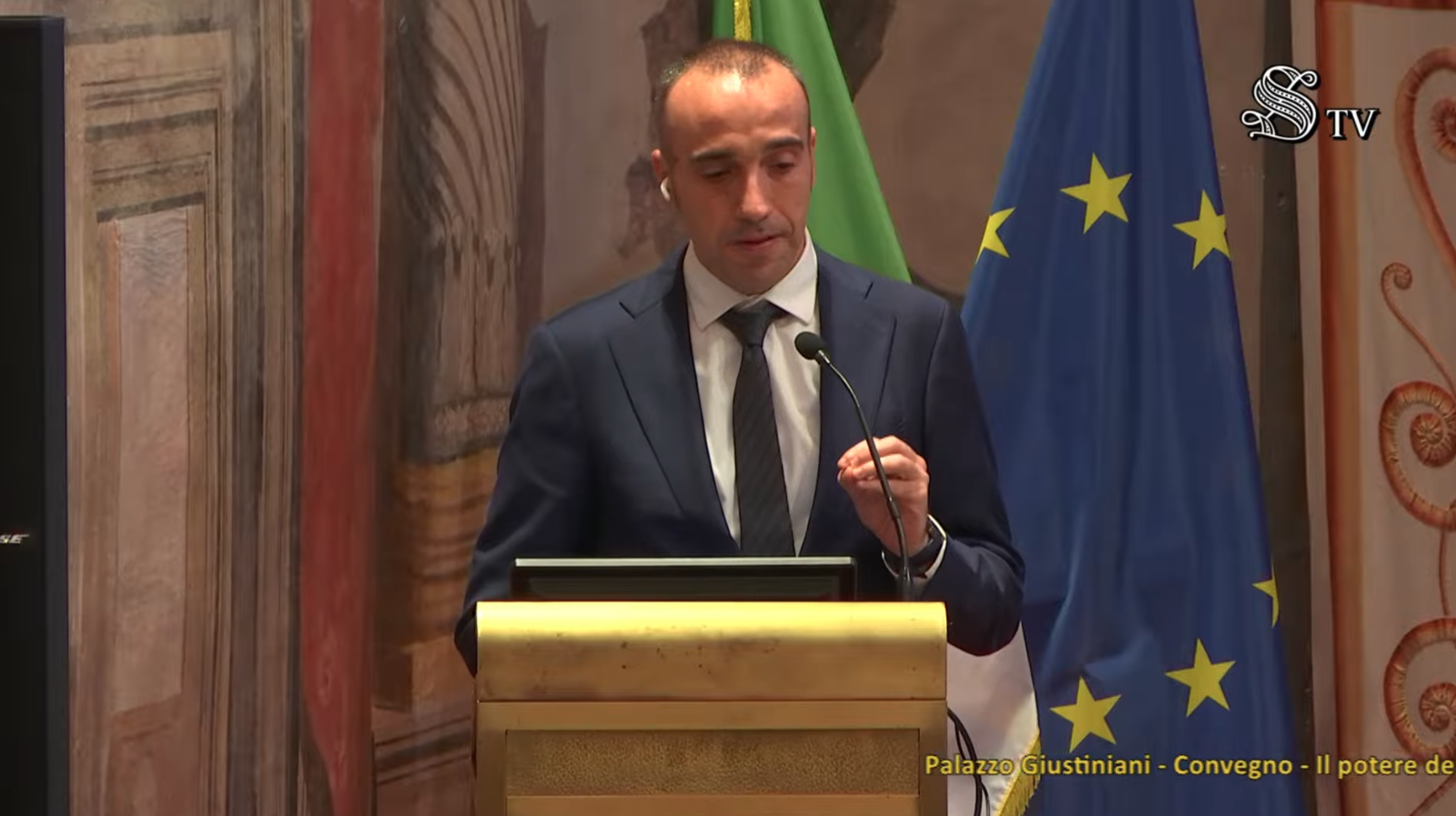

You speak at your industry's conferences as a presenter, you bring valuable content — but in AI answers it's the competitors who paid for the sponsorship that show up, not you. It's not a competence problem: it's that your name appears in a schedule table that the AI ignores, while the sponsor gets fixed structured citations on the event site, the press release and every post-event recap. To the AI it's a repeated trust signal; for the speaker, almost nothing. Three well-chosen sponsorships can be worth more than ten appearances on stage.
A conference sponsor is cited 5x more often than an attendee, and 2x more often than the organizer. Because the sponsor gets structured mentions — not generic ones.
This is the observation I open the article with, and I’ll explain it right away with the concrete case that made it obvious: a seismic engineering company from L’Aquila, specialized in anti-seismic technologies for the post-2009 reconstruction, which over four years had a presence at almost every industry conference as a presenter but not as a sponsor. The result: when you ask Perplexity “best Italian anti-seismic technology reconstruction companies”, the AI cites the competitors who paid to appear in the footer of the conference site, not the company that took the stage.
It’s not a competence problem. It’s a problem of mention structure: the sponsor lives in a repeated pattern (“sponsored by X”, “with the support of X”, “official partner X”) that AI engines read as a recurring trust signal. The speaker lives as a name dropped into a program table, which the AI often never associates with the brand behind the person.
What really happens when you sponsor an industry event
When you sign a sponsorship with a conference, you’re not buying a banner. You’re buying a high-authority web page (the event’s site), plus a distributed press release, plus a post-event recap, plus — in the good cases — a video interview with a transcript, plus a mention in the closing acknowledgments published on the organizer’s site.
Each of these assets is a structured mention: your brand always appears in the same syntactic format (“sponsored by”, “in partnership with”, “supported by”) on pages that stay online for years and get crawled (scanned) repeatedly by those building the datasets on which ChatGPT, Perplexity, Claude and Gemini run.
In the world of semantic retrieval research, the documented mechanism is this: language models weight entities that appear in recurring syntactic contexts and clear predicates more heavily than those appearing in ambiguous flowing text. A paragraph like “Mr. Rossi spoke about anti-seismic technologies” is far less recognizable, for an entity extraction system, than “Event X, sponsored by AziendaRossi Srl”. The first requires coreference resolution, the second is a direct trigger pattern. I covered this in detail in the articles on author entity recognition and on the event as an authority entity.
From this it follows that, for your business, investing €15,000 in a structured sponsorship produces a digital footprint that is more readable for the AI than €15,000 spent on a series of speaking appearances — for events of equal authority.
The reverse engineering I did on 10 events in the seismic-engineering sector
I took 10 Italian events from the 2022-2025 period tied to seismic engineering, post-earthquake reconstruction and structural reinforcement technologies. ANIDIS conferences, Reconstruction Forums, ISI days, regional events in Abruzzo-Marche-Umbria, Engineers’ Association seminars.
For each event I mapped three categories of actors: organizer, sponsors (all tiers), and speaker-attendees with no sponsor role. Then I queried ChatGPT, Perplexity and Gemini with 12 queries of the type “who are the leading Italian companies in [sub-sector]”, “which companies work with [technology X] in Italy”, “best [seismic product] suppliers in central Italy”.
The pattern I found, aggregating the citations obtained: sponsors were cited on average 5 times more often than non-sponsor speaker-attendees, and 2 times more often than the organizers themselves. The organizers pay the price of being a “neutral container”, whereas the sponsor inherits the event’s theme as a brand attribute.
To be honest: an indicative test, not a study. 10 events and 12 queries are a small sample, the pattern is consistent but not statistically closed. I report it for what it is — a strong signal, not a law. The real analysis is done only with professional AI citation monitoring tools over larger query volumes.
The operational takeaway holds, though: if you’re a structural engineering company from L’Aquila and you’re deciding between 3 free speaking appearances and 1 sponsorship at €12,000, the sponsorship gives you more readable AI mentions. For the same time budget.
I see contracts where the company pays €8,000 and on the event site only the PNG file of the logo appears, with no accompanying text.
Why the sponsorship contract matters more than the logo
Here’s a mistake I see made most often. The entrepreneur signs the sponsorship looking at the offline visibility package (booth, banner, logo on stage) and ignores the digital part. Which is exactly the part that produces the permanent AI signal.
When you negotiate a sponsorship, explicitly ask that the contract include:
- A mention on the event site with the company’s full name (not just an image logo: the alt text and the HTML text count)
- Presence in the official press release distributed to industry publications
- A post-event recap published on the site with your name explicitly cited
- A possible video interview with a published text transcript
- An outbound link from the event site to your corporate site, with anchor text that includes sector + brand
The image logo without alt text is practically invisible to the crawlers that feed AI datasets. The written text “anti-seismic technologies supplied by [AziendaX Srl]” in the recap, on the other hand, is a mention that stays citable for years. It’s the same logic as the backlink as a citation proxy: it’s not just about being there, it’s about the form in which you’re there.
Negotiate sponsorships where the contract explicitly includes a text mention on the site, the press release, and the digital recap
The mistakes I see most often
Over the last two years I’ve followed several businesses across Abruzzo, Marche and Umbria — typically companies between 10 and 60 employees in the reconstruction sector. There are four recurring mistakes.
First mistake: choosing to sponsor the wrong event. Sponsoring the local village festival brings nothing to the AI. It has to be an industry event, with a stable website, published by recognizable organizers (professional associations, trade bodies like ANIDIS, ISI, CNI).
Second mistake: logo yes, name no. I see contracts where the company pays €8,000 and on the event site only the PNG file of the logo appears, with no accompanying text. To the AI it’s noise.
Third mistake: no digital recap. Events that end and nothing remains on the site beyond the program page. Check in advance: ask to see the recap of the previous edition. If it doesn’t exist, you’re buying a physical banner, not a structured mention.
Fourth mistake: one-off sponsorship. One event a year doesn’t build a pattern. Two or three structured events from the same circuit, repeated for two or three years, create a recurring signature that the AI associates with the brand.
The test you can run in 20 minutes
Before signing a sponsorship, run this operational audit:
- Open the site of the previous edition of the event. Use Ctrl+F to search for the name of one of last year’s sponsors. If it appears fewer than 3 times in text form (not just as a logo), the site produces weak mentions.
- Ask Perplexity “sponsors [event name] [year] edition”. If the AI answers with precise names, it means the site was read and indexed in the datasets. If it answers “I can’t find them”, the signal isn’t getting through.
- Check the previous year’s post-event recap. Read it: count how many times the sponsors’ names appear in discursive paragraphs (not pure lists). Below 2-3 occurrences, the recap is thin.
These are rough thresholds, not lab-grade metrics. But in 20 minutes they tell you whether the sponsorship produces a structured mention or just offline visibility.
What to do in practice
If you’re planning your marketing budget for the next 12 months in your sector:
- Identify 2-3 key Italian events in your sector with a website that stays online after the event
- Negotiate sponsorships where the contract explicitly includes a text mention on the site, the press release, and the digital recap
- Repeat on the same 2-3 events for two or three consecutive editions: the recurring pattern is worth more than the quantity
- Compare with the 3-5 competitors the AI cites today in your sector: look at which events they appear in, decide whether to overlap with them or open a new front
It’s not a magic factor. Sponsorship alone won’t get you into AI answers if your corporate site is a semantic desert, if you have no technical content of your own, if you don’t have a Wikidata entry. It works as a multiplier of an already healthy ecosystem. If you’re building that ecosystem, the sponsorship accelerates it.
Where it fits into your AI-answer visibility strategy
Event sponsorship is one of the most underrated signals for visibility in AI answers precisely because it produces mentions in a structured form on high-authority pages — the kind of citation that AI engines read and remember for years.
In the next articles in this series I dig into the adjacent mechanisms: how mentions in industry press releases create semantic density, how co-citation between events of the same circuit amplifies the signal, and how to build a conference presence plan that works at the same time for offline clients and for the AI online.