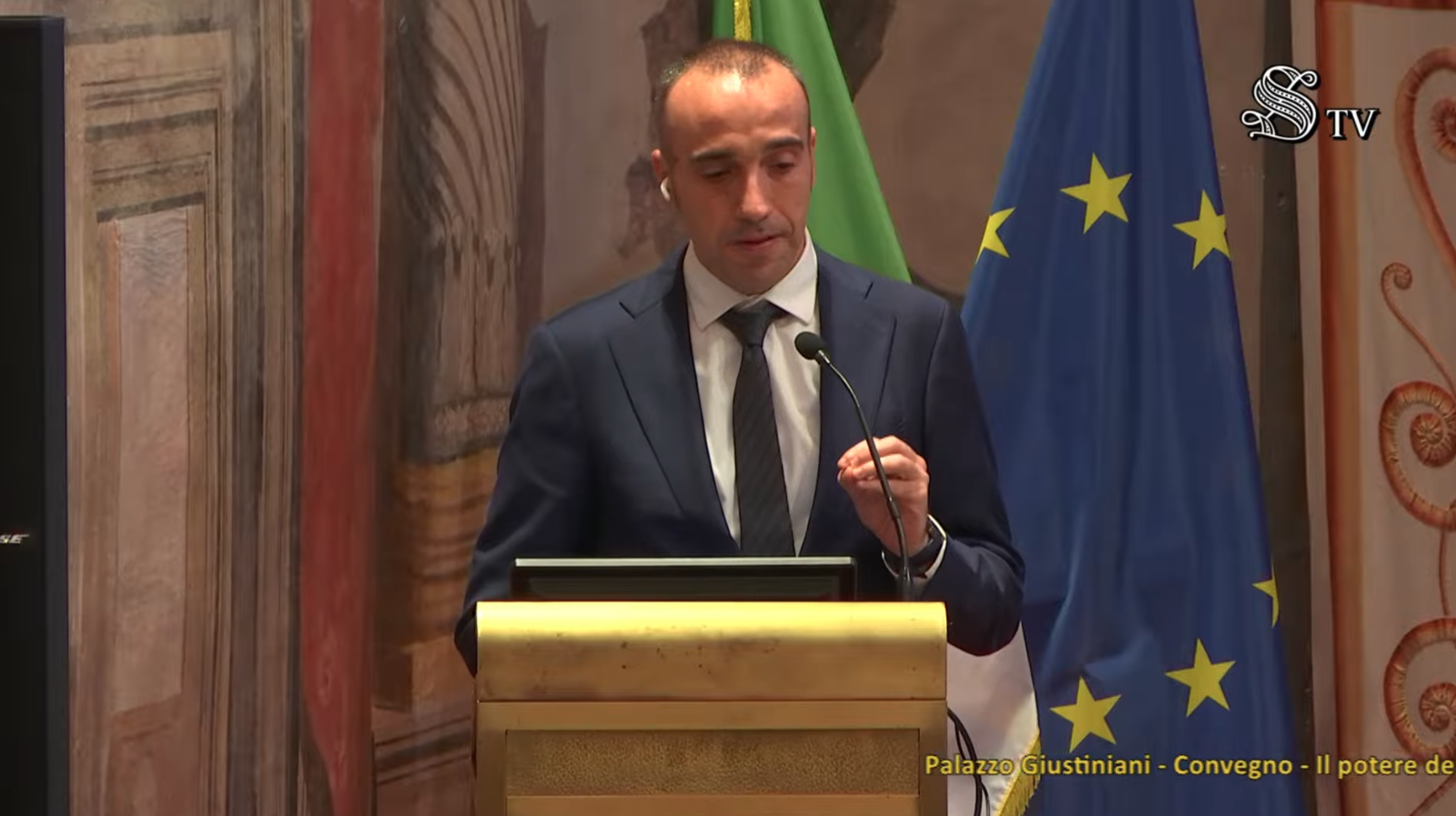

You speak at conferences, you have a solid reputation in your field — but when someone asks AI who the go-to expert on that topic is, your name never comes up. It's not a matter of competence: every time you step on a stage without negotiating how your speaker page gets published, you're wasting a permanent asset that could work for you for years. The competitors who understand this mechanism are leapfrogging you with less experience and more AI visibility. It takes very little to turn every talk into four lasting signals that the models recognize.
I remember the early TED talks: the speakers who walked on stage established their authority for 10 years. Today AI does something similar, but faster.
A speaker page from a conference you spoke at three years ago is still working for you inside ChatGPT, Claude and Perplexity. Every time you step on a stage and the organizer publishes your bio, with your name, your topic and the link to your site, you create an expertise signal that stays indexed for years. It’s one of the most underrated PR assets for showing up in AI answers.
In this article I explain why speaking engagements are an AI authority multiplier, what to measure, and how to negotiate with organizers to turn a 30-minute talk into 3-4 permanent digital assets.
What an AI model sees when you search for an expert
AI models don’t “know” who you are. They build an authority profile by reading the places where your name appears alongside your topic. Conference speaker pages are one of those places, and a particularly heavy one because they combine three signals in a single URL: personal name, vertical topic, institutional context (the conference).
In the field of research on LLM citation patterns, Andres Algaba et al. (2024) showed that the models mirror human citation patterns toward specific conferences and venues (publication outlets):
“In Appendix Figure B3, we observe that the distributions of publication venues for both ground truth and generated references are very similar across the various conferences, i.e., AAAI, NeurIPS, ICML, and ICLR.”
Translated for those who don’t come from academia: when an LLM generates references on a topic, it tends to call up the same venues (the same conferences) that humans would cite. The names of conferences and events are recognizable entities, weighted within the model.
The operational consequence is direct: appearing as a speaker at a recognized industry event increases the probability that your name shows up in the associations the model makes between topics and people. It’s not a magic factor, it isn’t enough on its own, but it’s a signal that stays online for years and keeps working.
Why speaking sits upstream of other authority signals
If you’ve read the previous articles in the series, the piece on Author Entity Recognition showed you how AI engines link author and topic. The piece on Event Entity and Speaking Authority introduced the concept of the event as an entity in the knowledge graph.
The speaking engagement is the point where these two things meet cleanly: a conference speaker page is a public, indexed page that cites your name next to a topic, inside the container of a recognized event. It’s the perfect person-topic-venue triangle.
Fourth mistake: chasing only the big stages.
The case study: a landscape architecture firm in Como, 12 months of measurement
Let me tell you a concrete case. A landscape architecture firm in Como, specialized in contemporary gardens for lakeside villas and landscape projects for resorts. Eight people, around 2 million in revenue, mid-to-upper clientele between Lombardy and Canton Ticino.
The problem was a classic one: their site was well crafted, they had a good photo portfolio, but when a client asked ChatGPT “best landscape architecture firms in northern Italy” or “who designs contemporary gardens on Lake Como”, their name never came up. Instead, smaller firms that were more frequently cited in the industry press came up.
Intervention: for 12 months we worked only on speaking. No additional content marketing, no bought backlinks, nothing. They took part in 8 talks: two Assopaesaggisti conferences, a panel at Fuorisalone in the outdoor section, two workshops at schools of architecture (Politecnico di Milano and IUAV), a talk at a hospitality trade fair in Rimini, an appearance at a garden culture festival, a lecture in a university master’s program.
For each engagement we negotiated three minimum assets with the organizers: a speaker page with a 200-word bio and a link to the site, a public video recording of the talk on YouTube, a recap blog post on the organizer’s site with a textual mention of the speaker.
Before/after measurement: at the start of the period we tested 12 vertical queries on ChatGPT, Claude and Perplexity — things like “landscape architecture firms Como”, “contemporary garden designers northern Italy”, “who designs landscape for resorts on the lake”. Zero brand citations across all 12. After 12 months with the same query set: the firm’s name appeared in 7 answers out of 12 on Perplexity, 5 out of 12 on ChatGPT, 4 out of 12 on Claude.
Stated limitations: small sample, single client, variables not perfectly isolated (in the meantime they had published a project in an industry magazine). But the pattern is clear and replicable: 8 well-negotiated appearances in 12 months produced a visible signal in AI answers on commercially relevant queries.
In the research world, the same paper by Andres Algaba confirms the pattern of linkage between venue and reference:
“Finally, the scatter plot affirms the strong pairwise correlation between the ground truth and generated references to the top conferences at the individual paper level.”
From this it follows that consistency between topic and venue matters: 8 talks scattered across different themes would have produced less signal than 8 talks converging on the same expertise.
For each event you accept, negotiate the asset package: speaker page with a full bio and link, public video, recap blog post.
The mistakes I see most often
First mistake: accept the talk, give the talk, go home. Zero negotiation on the digital assets. The event lives for 45 minutes and then disappears. The question to ask the organizer before signing is just one: “Does my speaker page stay online? Is there a recap blog post? Does the video get published?”. If the answer is no on all three, the talk is only worth it as networking.
Second mistake: a generic bio. A speaker bio like “professional with 15 years of experience” tells AI engines nothing. You need a bio with strong entities: firm name, city, specific vertical, 2-3 recognizable projects, link to the site. The Como firm rewrote its bio like this: name, role, “landscape architecture firm based in Como, specialized in contemporary gardens for private residences and landscape projects for hospitality on Lake Como and Canton Ticino”.
Third mistake: not asking for the video recording. YouTube is a very high-authority domain that AI engines read. A video with your name in the title and the description, hosted on the organizer’s official channel, is a free permanent asset.
Fourth mistake: chasing only the big stages. A panel at a 200-person vertical conference produces more AI signal than a generic talk at a 2000-person event with a bare-bones speaker page. Ten well-documented specialist events beat three big stages with no assets.
I’m working to diversify traffic sources so I’m not relying solely on traditional search. YouTube, for example, remains one of the most effective channels for many businesses to reach new customers.
I believe companies will need to invest across multiple channels to keep growing, from search and social media to YouTube. Relying on a single source of traffic is no longer a sustainable strategy.
The test you can run in 15 minutes
Three concrete steps to figure out where you stand today:
- Open ChatGPT and Perplexity and ask “who are the experts in [your vertical topic] in [your city or region]”. Note whether you appear or not. Repeat with 4-5 variations of the query.
- Search Google for “[your name] speaker” and “[your name] [topic]”. Count the institutional event pages where you appear. Under 3 you’re invisible, 3-8 you’re building, over 8 you have a portfolio.
- Open the first 5 speaker pages that concern you. Check: bio up to date? Link to the site working? Specific topic? If these elements are missing, the asset is wasted.
This is an entry-level check. Real analysis, with continuous query monitoring and competitor comparison, requires professional tools.
What to do concretely over the next 6 months
- List 10 industry events relevant to your vertical in 2026. Not the biggest ones: the most specific ones.
- Contact the organizers with a concrete talk proposal, not a CV. An angle, a perspective, a case study.
- For each event you accept, negotiate the asset package: speaker page with a full bio and link, public video, recap blog post.
- Reuse every talk: extract 3-4 posts from the content, publish them on your site linking the event’s speaker page. Close the loop between the event and your domain.
- Measure before/after with a fixed set of 10-15 queries on AI engines, every 3 months.
The thread with AI visibility
Speaking is one of the Digital PR channels with the best ratio between effort and signal duration. An article in a publication can lose position within 12 months. A speaker page stays there for years, indexed, with your name next to your topic inside a recognized event. It’s one of the cleanest ways to build authority perceived by AI.
In the following articles in this series we’ll go into detail on how to build the pitch for conferences, how to turn a talk into 4 multiplier assets, and how to measure the impact of Digital PR on AI citations over time.