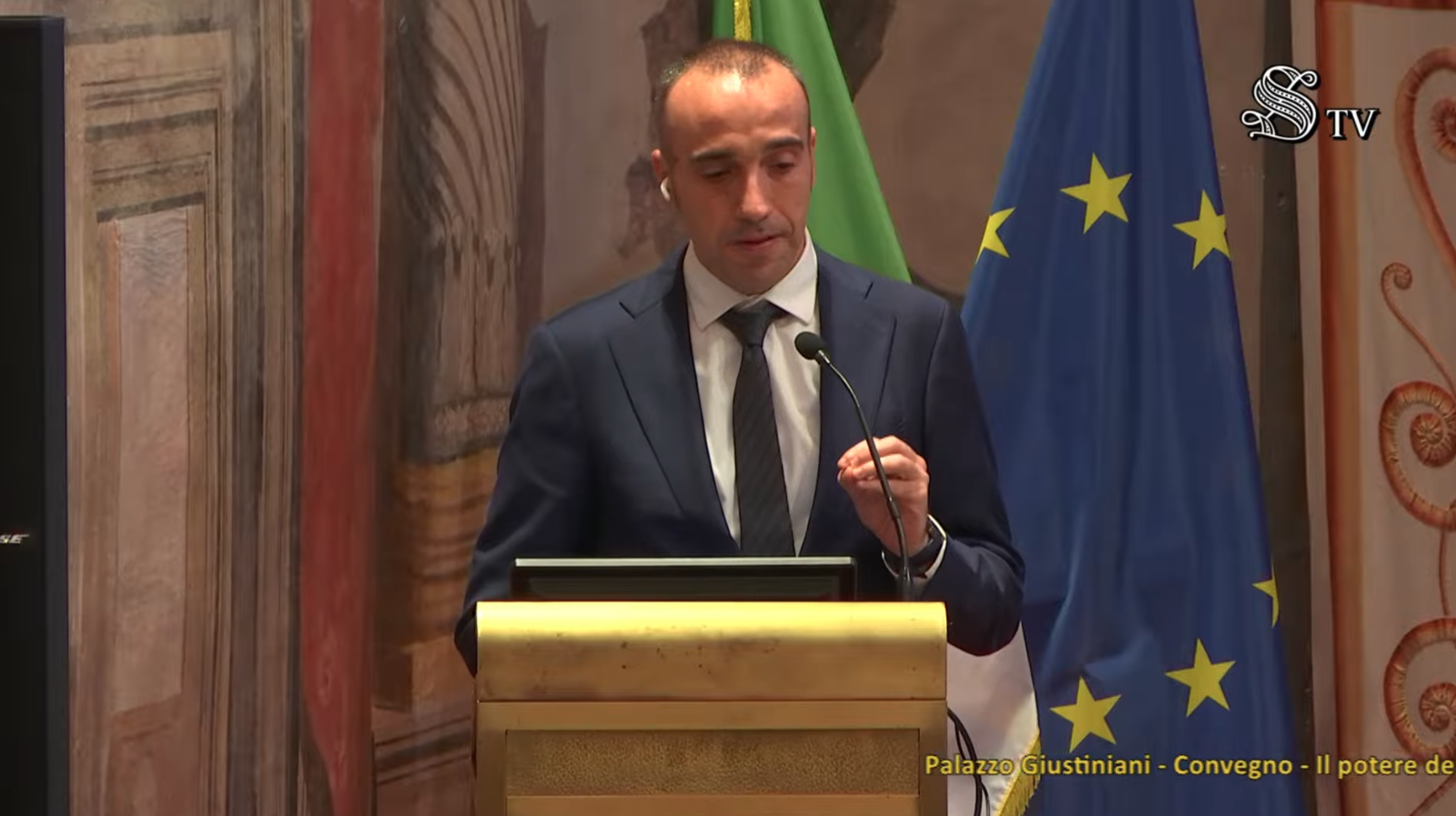

You've been speaking at conventions and conferences for years, but when ChatGPT answers questions about who the experts in your field are, your name never shows up. It's not a reputation problem: your talks, the way the organizers publish them, leave no traces that AI models can read. Every conference you've taken part in could be a permanent authority node working for you — and instead it's invisible. Making those talks visible to AI is a matter of just a few concrete steps.
Picture this scenario. A potential client opens ChatGPT and asks “who are the Italian industrial automation experts who do training?”. The AI replies with three names. The owner of TecnoImpianti Soluzioni Industriali has been a speaker at four industry conferences over the last two years, has a website with a bio and a well-curated LinkedIn profile — but he doesn’t show up. The two competitors who do show up have less hands-on experience, but the AI can confidently link them to recognized public events.
The difference isn’t in the expertise. It’s in the fact that AI engines read events as separate authority nodes, and every time your name is cleanly tied to a recognized event, you gain a small piece of credibility that a simple “about me” can’t give you. In this article I’ll explain how the mechanism works, how to test whether your public talks are visible to AI, and what to ask organizers so you don’t waste the hours you spend on stage.
We’re entering an era where facts are becoming a commodity, something that can be bought and sold. What will truly matter are proprietary data, unique products, strong brands, and the people behind them. It’s a form of marketing that no longer depends on content in the traditional sense.
What an AI sees when your name appears in a speaker list
In the world of Knowledge Graph research, events are treated as a category in their own right, distinct from people or companies. Guan et al. (2021), in the survey What is Event Knowledge Graph, formalize this distinction by introducing the concept of the Event Knowledge Graph (EKG): alongside entity-centered knowledge — people, organizations, places — there is event-centered knowledge, which represents the dynamic, procedural part of the real world. An EKG links events to one another and links events to the entities that take part in them, with specific roles: organizer, speaker, attendee.
From this follows something very practical for your business: in the knowledge graph the AI uses to answer questions, “Roberto Rossi” and “Predictive Maintenance Conference 2025” are two distinct nodes, connected by a typed relationship “spoke at”. When an AI engine has to decide whether to cite you as an expert, it weighs the quantity and quality of these relationships. A person node with no events attached is a flat profile. A person node connected to three recognized conferences is a profile with depth over time.
The work of Li & Geng (2024) on GraphERE adds an important detail: relationships between events (causality, temporal sequence, co-participation) are extracted better when each event has a structured representation. Translated: an event described only as free text on an “about us” page carries far less weight than an event that has a clearly separated date, location, organizer and speaker list.
Why this sits upstream of everything else I’ve told you about
In previous articles I explained how AI recognizes entities, how it links them to the Knowledge Graph, and how it assesses an author’s credibility. I told you how the author recognition system works and why E-E-A-T for AI isn’t a matter of keywords but of verifiable traces.
Events are one of the strongest verifiable traces there are. A conference has a date, a physical location, an organizer with a VAT number, a published program, often a video or a photo. It’s a “fact” the AI engine can cross-check against three or four independent sources. A bio on your website is a one-sided statement. The difference in trust the system assigns to the two signals is enormous.
If you’re a speaker at an event and the only way to see yourself on the program is to download a PDF, then as far as the Knowledge Graph is concerned, you’re not there.
The test you can run in ten minutes
Take the most recent event you spoke at. If you’ve never spoken in public, take an event in your field that you’d like to do next year. Then go through these steps.
Step one: copy the URL of the event page and paste it into Google’s Rich Results Test. It tells you whether that page has a valid Event schema. If you see “Event” among the detected types, the organizer did the work. If you see nothing, then to the AI the event is just a chunk of HTML text.
Step two: go to Wikidata and search for the name of the event. If there’s a dedicated Wikidata page, you’re in pole position: Wikidata is one of the structured sources the large models use during training. If there isn’t one, that’s a piece of work you could propose to the organizer for the next edition.
Step three: open ChatGPT, Claude, Perplexity and Gemini, and ask the same question four times: “who spoke at the [event name] in [year]?”. If three engines out of four name you, you’re inside the graph. If none of them name you but they do name other speakers from the same event, the problem isn’t the event — it’s you who are invisible. If none of them name anyone, it’s the event that hasn’t crossed the recognizability threshold.
A simple decision threshold: at least two AI engines out of four should name you when the query is about the single event. Below that threshold, the work on the speaker entity needs to be redone.
After the event, write a post on your website with a title that contains the event name + the year, and link to the official page.
The test I ran on a sample of Italian conferences
I analyzed forty editions of Italian B2B conferences from the last three years — in the manufacturing, legal and medical sectors — to understand how many of the speakers listed on the program were actually visible in AI answers.
The result, on a small but consistent sample: only 11 events out of 40 had a valid Event schema on the official page. Another 14 had a text speaker list but no structured markup. The remaining 15 had only a downloadable PDF of the program, which to the AI is almost invisible.
For the speakers, I tested 60 names drawn at random, asking four AI engines “which edition of [event] did [name] speak at?”. 63% of speakers connected to events with a valid Event schema were correctly identified by at least two engines out of four. Among speakers connected only to a PDF program, the percentage collapsed to 12%. The difference is stark.
This is an indicative test, not an academic study: the sample is small, there are only three sectors, and the behavior of AI engines changes from month to month. But the pattern is clear enough to justify the operational work. Serious analysis requires professional Knowledge Graph audit tools and a sample in the hundreds, but even this first check tells you which way to look.
The mistakes I see most often
Putting the speaker list inside a PDF. A classic of old-school organizers. A PDF is an attachment: the content is there, but it isn’t structured in navigable HTML, it has no schema, and often AI crawlers don’t even read it well. If you’re a speaker at an event and the only way to see yourself on the program is to download a PDF, then as far as the Knowledge Graph is concerned, you’re not there.
Using the company name instead of the person’s name. “TecnoImpianti Soluzioni Industriali will speak” instead of “Dott. Mario Rossi of TecnoImpianti Soluzioni Industriali will speak”. The AI engine extracts entities: without the person’s proper name it can’t link the participation to an individual. The person node is left orphaned.
Changing your bio at every event. At one conference you’re a “senior trainer”, at another a “strategic consultant”, at a third an “Industry 4.0 maintenance expert”. To the AI these are three versions of you, and the consistency of your profile in the Knowledge Graph weakens. Keep a short canonical bio (three or four lines) identical everywhere, and attach a variable extended version.
Not asking for a link to your own site or LinkedIn from the speaker page. A speaker list with no links is a list of ambiguous strings. “Mario Rossi” is your name but also that of a thousand other Italian professionals. The link to your profile resolves the ambiguity and tells the AI “this Mario Rossi is that Mario Rossi”. Without a link, the system has to guess and often gets it wrong.
Not following up on post-event materials. Slides never published, videos never uploaded, no summary post on your blog. After six months, the only trace that you were at that event is a line in the program, buried in a forgotten page. A post on your site “what I talked about at conference X” with a link to the speaker page doubles the correlation signals for the AI.
What to do concretely before the next event
- Ask the organizer to publish the speaker list in HTML with Event schema (send them the link to the Rich Results Test, so they get it).
- Provide your full proper name, a canonical bio of three or four lines, a link to your site and to your LinkedIn.
- After the event, write a post on your website with a title that contains the event name + the year, and link to the official page.
- If the event has a hashtag, use it consistently on your channels in the following days.
- After six months, repeat the test on the four AI engines to see whether your participation has been absorbed into the graph.
- Compare yourself with the three to five competitors the AI cites in your field when you ask “who are the experts in [your area]”: how many events they have, how often, and with what kind of coverage.
Where this work leads for your visibility in AI answers
Building a solid “person” node in the Knowledge Graph is a two-stage job. The first is cleaning up the fundamental data — bio, website, public profiles. The second is building verified relationships with other nodes: events, publications, co-authors, clients. Events are the easiest type of relationship to obtain and the strongest to defend, because every event is publicly verifiable and lasts over time.
It’s not a magic factor: speaking at three conferences isn’t enough to become the name ChatGPT cites first. But it’s a brick that carries weight, and in my experience it clearly separates the profiles the AI names from the profiles the AI ignores. In the next articles in the series I’ll tell you how other types of entity-to-entity relationship work — partnerships, co-authorship, institutional affiliations — that complete the picture of your presence in the graph.